 |
|
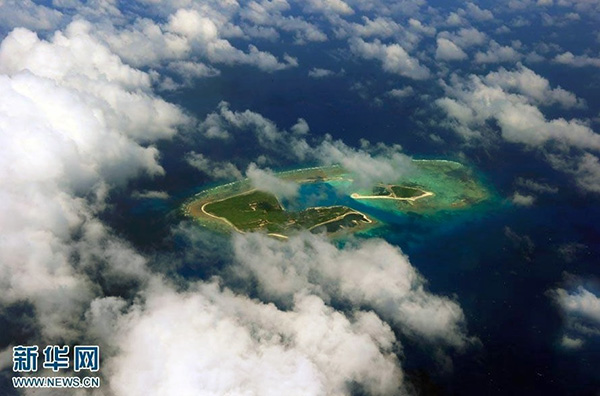
File photo of South China Sea. [Photo/Xinhua] |
Since the South China Sea arbitral tribunal, set up on the Philippines' request, issued its first "award" on jurisdiction and admissibility, the lawfare between China, on one side, and the United States with its allies and partners, on the other, has focused on the legality of the tribunal's jurisdiction over the case. After the arbitral tribunal issues its final "award" on July 12, the Sino-US lawfare will change accordingly.
The US side seems well prepared for this change. Besides massing the South China Sea with its defense forces, the US and its allies have also more strongly demanded that China respect the tribunal's final ruling. This means the Sino-US lawfare will revolve around the legal consequences of the ruling. The conflict, for example, will be on whether the ruling is binding on China or not, its status in international law and whether its non-recognition is equivalent to rejection of international law. These points will be used by the US and China to gain global diplomatic support.
Generally, an arbitral tribunal's ruling is binding on both parties. But the exception proves the rule. It is fairly generally accepted under international law that the excess of power may be treated as a nullity. That's exactly the position taken by China that the arbitral tribunal exercised jurisdiction ultra vires and any of its decisions have no legal effects. Since these exceptions are known only by a small group of legal experts, the US and its allies claim the arbitration court's ruling is binding on China, while China has to make extra efforts to explain to the international community why the "award" cannot be applied to it. The US and its allies will use this advantage to put pressure on China to abide by the "award".
Even if we suppose an arbitral "award" is binding on both parties, its enforcement will remain a separate issue. Usually, an arbitration's success depends on the "goodwill" of the parties to implement its ruling. But unlike the legal system of a country, the rulings of internation adjudications cannot force a state party to undergo punishment-rulings of the International Court of Justice is exceptional as Article 94 of the UN Charter says one party may have recourse to the UN Security Council to enforce the ICJ's decision.
Since the Philippines' case was handled by the 1982 UN Convention on the Law of the Sea Annex VII arbitral tribunal, its decision cannot be enforced by any party. The US, however, could portray the arbitration court's "award" as a verdict of the ICJ to gain global support for its enforcement. Worse, it could use the "award" as a legal excuse to flex its military muscles in the South China Sea, which would contravene the general principle of international law banning the use of force in international relations.
But will the non-implementation of the "award" be equivalent to contravening international law? Article 38 of the Statute of the ICJ says the sources of international law are international treaties, customs and general principles of law, and judicial decisions can only be used as a subsidiary means to determine the rule of law rather than as an actual source of law. But the US might exploit the disconnection between the informed small group of experts and the general public over this legal fact to say China does not follow international law.
The fact is, the US is least qualified to criticize China on this point, because it is the only country to use veto in the UN Security Council to prevent the enforcement of an ICJ decision (in the Nicaragua case). But instead of being ashamed of their country's illicit act, many US politicians and scholars are now voicing another lie-that China will violate the rule of law by not recognizing the arbitration court's "award".
Even the Philippines believes the arbitral tribunal's decision in the Southern Bluefin Tuna case was wrong. Does this mean non-compliance with international law by the Philippines? If not, isn't the US' position a clear sign of double-standard?
The best approach for China to expose the US' trickery and to win this battle is to tell its side of the story to the international community, that is, explain the general rule versus exceptional rule.
Zhao Yishui is a research fellow with the South China Sea Institute of Xiamen University, and Liu Haiyang is a research fellow at the Collaborative Innovation Center of South China Sea Studies of Nanjing University.


Copyright 1995 - . All rights reserved. The content (including but not limited to text, photo, multimedia information, etc) published in this site belongs to China Daily Information Co (CDIC). Without written authorization from CDIC, such content shall not be republished or used in any form. Note: Browsers with 1024*768 or higher resolution are suggested for this site.
License for publishing multimedia online 0108263 Registration Number: 130349