 |
|
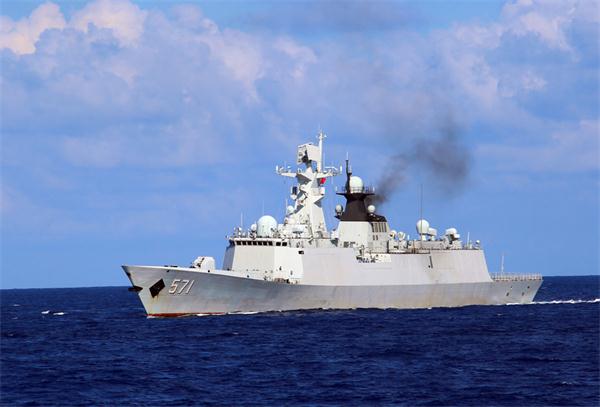
Missile destroyer Guangzhou launches an air-defense missile during a military exercise in the water area near south China's Hainan Island and Xisha islands, July 8, 2016. Chinese navy conducted an annual combat drill in the water area near south China's Hainan Island and Xisha islands on Friday. [Photo/Xinhua] |
After the Philippines filed a case in The Hague-based Permanent Court of Arbitration against China in the South China Sea dispute, Beijing has made it clear that it would neither participate in nor accept the ruling of the arbitral tribunal. But despite the extensive international support it has received, Beijing's "non-participation and non-acceptance" stance has been criticized by some Western countries.
There is, in fact, a precedent of "non-participation and non-acceptance" of a ruling by a third party to settle an international dispute. In the Nicaragua case of the 1980s, the then Ronald Regan-led US administration took a "non-participation and non-acceptance" stance when the International Court of Justice accepted the case; it eventually passed a ruling that went against the US.
Subsequently, although Nicaragua submitted the case twice to the United Nations Security Council for discussion, the US used its veto as a permanent Security Council member to foil its passage. Noticeably, the Security Council's members such as Britain and France and Thailand, too, refused to support Nicaragua's demand for the implementation of the ICJ ruling, by abstaining from voting on the discussion under various pretexts. By abstaining from voting, these countries indicated they, as Security Council members, chose to take into consideration extensive political factors, though they could support the ICJ verdict.
The Nicaragua case testifies that not all rulings of international courts are recognized or implemented by one or the other party. A comparison of the cases whose rulings were implemented and those whose rulings were not recognized shows the factors that would decide whether the Permanent Court of Arbitration's ruling in the Philippines' case is recognized and implemented include whether the tribunal has jurisdiction over the case and whether it passes a flawless ruling.
Manila has employed some top international lawyers to disguise the arbitration dispute with China as a case to seek separate legal status for some islands and reefs in one of China's island chains in the South China Sea to make it seem The Hague-based tribunal has jurisdiction over it. This is why the tribunal announced it does have the power to arbitrate the case. But while passing a ruling on the substantial contents of the case, the court will face a dilemma.
If it extends full support to the Philippines, its ruling will inevitably involve territorial sovereignty and thus go beyond the scope of the UN Convention on the Law of the Sea or will extend to an area in which China has announced its reservation. If true, this will push the court's ruling beyond the limits of its jurisdiction and thus challenge its legitimacy.
And an abstract ruling irrelevant to territorial sovereignty and demarcation of the waters in order to avoid the above-mentioned embarrassments will make its ruling impractical for implementation.
Either of the scenarios will automatically give China the right to not recognize and implement the ruling.
Different from the South China Sea arbitration case-in which the ruling is likely to stop short of having enough and binding content for implementation-the ICJ verdict in the Nicaragua case explicitly said the US should stop violating international law and compensate the losses it has caused to Nicaragua. So if the US, which has ignored the ICJ verdict, pressures China to implement the arbitral tribunal's ruling, it will be guilty of using double standard.
China's refusal to implement the arbitral tribunal's ruling-because it doesn't have jurisdiction over the case-will not mean it is violating international law. In fact, the great efforts China has made to resolve the South China Sea disputes with neighbors both at bilateral and regional levels reflect its commitment to using non-judicial procedures to settle them without the intervention of a third party.
Third-party arbitration is not a panacea for international disputes. And China's contribution to international peace will not be belittled because of its refusal to implement the arbitral tribunal's ruling.
The author is an associate professor of international law at the Southwest University of Political Sciences & Law, Chongqing.


Copyright 1995 - . All rights reserved. The content (including but not limited to text, photo, multimedia information, etc) published in this site belongs to China Daily Information Co (CDIC). Without written authorization from CDIC, such content shall not be republished or used in any form. Note: Browsers with 1024*768 or higher resolution are suggested for this site.
License for publishing multimedia online 0108263 Registration Number: 130349