 |
|
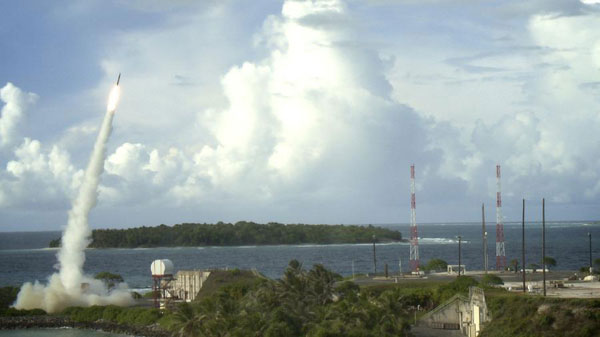
A Terminal High Altitude Area Defense (THAAD) interceptor is launched during a successful intercept test, in this undated handout photo provided by the US Department of Defense, Missile Defense Agency. [Photo/Agencies] |
The Democratic People's Republic of Korea reportedly launched a submarine-based ballistic missile on Saturday. The launch came a day after Seoul and Washington jointly announced their decision to deploy the US-made Terminal High Altitude Area Defense system in the Republic of Korea to "better tackle the DPRK's nuclear and missile threats".
On Friday, immediately after the US-ROK announcement, China and Russia expressed strong opposition to the move. China's Foreign Ministry said in a statement posted on its website that the deployment will "do nothing to help with denuclearization of the Korean Peninsula, and (instead) will harm regional peace and stability".
The deployment of THAAD on ROK soil will pose a grave threat to China's core security interests and seriously affect the international situation. To begin with, it is likely to further undermine the strategic trust between China and the US. As a rising global power, China has adopted the best possible approach to deepen its cooperation with the US. That explains why President Xi Jinping has more than once emphasized the importance of establishing "a new type of major-power relationship" between the two countries.
Yet little progress has been made because the US remains suspicious of this proposal. Instead, the US has made an even bolder move than its "pivot to Asia" strategy by getting the ROK's nod to install THAAD, which will threaten China's key national interests and challenge its peaceful rise.
The Beijing-Seoul relationship, which is enjoying its best phase, will also fall victim to the US move. The fruitful high-level exchanges between China and the ROK in recent years have a lot to do with the fact that Seoul, a Washington ally in Northeast Asia, has refrained from picking sides as China and the US struggle to resolve vital security issues.
The deployment of THAAD in the ROK is in essence part of the US' zero-sum game. That the ROK finally accepted the US' proposal means it has decided to forego its neutral stance and side with its ally to contain China. The US-ROK move will also create more uncertainties for the region, especially because the DPRK's nuclear issue is yet to be resolved.
On the one hand, Beijing and Moscow have opposed the deployment of THAAD in the ROK, and will keep opposing to it through different channels. On the other hand, since outside intervention has played a limited role in persuading Pyongyang to abandon its nuclear plans, the trilateral cooperation between Beijing, Washington and Seoul should not be ignored because it has proved to be the most effective means of curbing the DPRK's nuclear program. As such, efforts by China, the US and the ROK may be undermined after THAAD's deployment.
In fact, Seoul has more to lose than gain from its decision to allow the US to deploy THAAD. A stable, healthy China-US relationship is in the interest of the ROK, because it has maintained fruitful ties with both countries and thus cannot afford to lose either in case of a serious confrontation between the two.
China will not sit idle if its security interests are threatened. It may resort to economic sanctions and restrictions on personnel exchanges-it could even halt military exchanges and cooperation-to put its relationship with the ROK on the right track. This is apparently more than Seoul could take, particularly when it is struggling to improve its ties with Tokyo and Pyongyang.
The ROK's lack of strategic contemplation should be blamed for its ill-advised decision. Fearing that it cannot cope with the security threats in the neighborhood without the help of the US military, the ROK, especially its defense department that has a stake in the purchase and maintenance of THAAD, found it difficult to refuse the US deal. However, such shortsightedness will benefit neither the ROK nor the regional order.
The author is an associate researcher at the National Institute of International Strategy of the Chinese Academy of Social Sciences.


Copyright 1995 - . All rights reserved. The content (including but not limited to text, photo, multimedia information, etc) published in this site belongs to China Daily Information Co (CDIC). Without written authorization from CDIC, such content shall not be republished or used in any form. Note: Browsers with 1024*768 or higher resolution are suggested for this site.
License for publishing multimedia online 0108263 Registration Number: 130349