 |
|
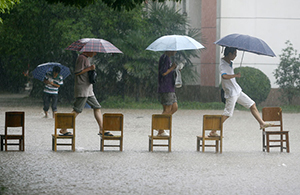
LI FENG/CHINA DAILY |
The floods in South and Central China continue making headlines. Photographs of soldiers trying to protect embankments against the floods have been splashed across newspapers. But the cameras seem to be trained on the main stream of the Yangtze River. The threat from the Yangtze is real yet the cameras (and reports) should not ignore the dangers posed by small and medium-sized rivers.
According to official data, water at 51 points in 39 small rivers in the lower reaches of the Yangtze River had risen above the danger levels on July 10-at three points the levels were the highest in recorded history. Once an embankment breaks, the gushing waters could pose a serious threat to lives and properties. The threat to embankments on smaller rivers is more serious because they have been made with earth, not cement, and cannot withstand massive floods.
Rivers in China fall into different grades, with the upkeep of only the top ones, such as the Yangtze River and Yellow River, being the responsibility of the State. The upkeep of the other rivers is the responsibility of various levels of local governments.
The first problem with such governance is insufficient funds, because local governments don't have enough money to build or bolster embankments. Until the 1990s, this didn't pose a big problem because villagers, desperate to protect their homes, crops and other properties, could be recruited to work for free on the embankments. But the rapid pace of urbanization and migration from village to cities have made that arrangement unviable.
Some provinces tried out a new model to build embankments. For example, in East China's Zhejiang province, some local governments invested funds to build the embankments with cement and then sold the land nearby to realty developers to get their investments back. This arrangement worked when the real estate market was flourishing, but with the property market withering it is no longer sustainable.
Also, since local governments in flood-prone areas have to regularly strengthen the embankments, which becomes difficult when the land nearby is turned into a residential area and the residents face high risk of flooding during the rainy season.
In 2013, a high-end housing community in Chengdu, Southwest China's Sichuan province, was reportedly flooded. The houses built near the Jiang'an River fetched very high prices because they offered a grand view of the river. Yet they suffered during floods.
Another problem with the current river governance is lack of coordination among neighboring areas. For example, neighboring areas don't coordinate on which part of an embankment should be strengthened and which part should be designed as a flood-discharge area. Such decisions have to be made after conducting a thorough study of a river. But the current governance system "divides" smaller rivers into small parts and puts them under the governance of separate villages, which unfortunately do not coordinate on flood-control measures.
Residents of a village tend to strengthen the parts of an embankment that are vital to their own safety. As a result, floods breach the weaker parts in other areas, and economically weak villages suffer the most during floods because they cannot afford to build strong embankments.
Realizing both problems, the central government has been investing heavily since 2009 to build strong embankments. In 2012, it completed the work of strengthening key parts of embankments on small and medium-sized rivers. Although more needs to be done, the move raises hopes that first problem, of lack of funds, can be solved.
But the second problem-lack of coordination-is yet to be fully addressed. It is impossible to put all rivers under State governance, but at least coordinating committees should be set up for small rivers, so that their embankments are built in an orderly way to prevent and control floods.
Cheng Xiaotao is associate engineer-in-chief at China Institute of Water Resources and Hydropower Research. This article is an excerpt from his interview with China Daily's Zhang Zhouxiang.


Copyright 1995 - . All rights reserved. The content (including but not limited to text, photo, multimedia information, etc) published in this site belongs to China Daily Information Co (CDIC). Without written authorization from CDIC, such content shall not be republished or used in any form. Note: Browsers with 1024*768 or higher resolution are suggested for this site.
License for publishing multimedia online 0108263 Registration Number: 130349