 |
|
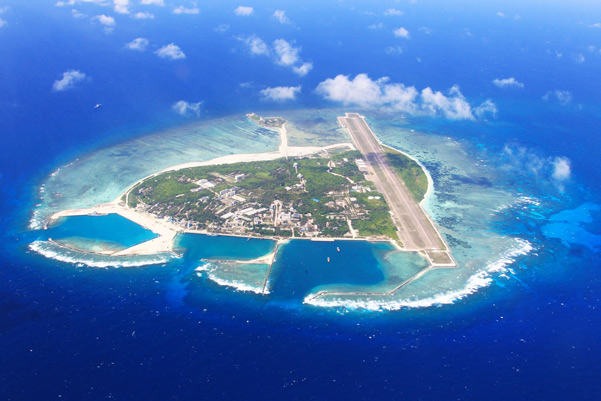
Yongxing Island is home to the government of Sansha, China's southernmost city. [Photo/Xinhua] |
The Hague-based arbitral tribunal on Tuesday passed its ruling on the case unilaterally brought by the Philippines in its dispute with China in the South China Sea, but China remains firm on its stance of "non-acceptance, non-recognition and non-compliance". There is enough reason for China to do so, because the ruling, along with the arbitration, is null and void and thus not binding.
The Philippines filed the case three years ago without the consent of China, which since then has been reiterating the reasons for refusing to accept the arbitration and the ruling. Since Manila's unilateral move is a violation of international law and judicial practices, the arbitration and ruling make no difference to China's legal status in the South China Sea.
The issues Manila submitted to the arbitral tribunal were, in fact, beyond the scope of the United Nations Convention on the Law of the Sea. There are still disputes over China's maritime claims in the South China Sea, and whether China's legal actions in the waters infringed other neighbors' interests is related to territorial claims and maritime delimitation, which are beyond the realm of UNCLOS.
Besides, the Philippines resorted to the arbitral tribunal when options of peaceful bilateral negotiations had not been exhausted; it also failed to fulfill its obligation to compare notes with China, which exercised its right under Article 298 of UNCLOS by making a declaration excluding compulsory arbitration. Given these facts, among many, the Hague-based tribunal had no ground to accept Manila's case.
Since 1995, "consent" has been repeatedly emphasized in the documents jointly issued by Beijing and Manila, in a bid to make clear their respective obligations in negotiations. The Declaration on the Conduct of Parties in the South China Sea agreed by both sides in 2002, too, highlights the term "promise" in Article 4, to ensure territorial disputes are addressed peacefully by the parties directly involved through consultation and negotiation.
So by hyping up 15 cases that do not define Beijing-Manila ties, the Philippine government led by former president Benigno Aquino III dishonored the bilateral agreements with China. At their earlier talks on bilateral disputes, both sides had focused on emergencies in areas of dispute and the measures needed to reduce frictions, none of which are reflected in Manila's arbitration.
As such, the tribunal's ruling will have no impact on China, because the country's decision to not accept or implement it is in line with UNCLOS, which should be respected by one and all.
In a statement justifying its "jurisdiction" over the Philippines' case, the tribunal separated a country's maritime interests from its sovereignty, while questioning the validity of bilateral or multilateral agreements because they do not rule out the possibility of third-party intervention. Such misinterpretations can harm the legitimacy and authority of UNCLOS, making it difficult for disputing countries to solve their problems through bilateral or multilateral channels.
China's presence in the South China Sea is legal and historical, from administrative management and navigation to salvage operations, and UNCLOS, a relatively modern convention, alone cannot repudiate its interests in these waters.
The Declaration of the Government of the People's Republic of China on the Territorial Sea of 1958 and the Law of the People's Republic of China on the Territorial Sea and the Contiguous Zone of 1992 also make it clear that China's territorial claims are about archipelagos, not single reefs or islets, in the South China Sea. That further nullifies the tribunal's attempt to decide the ownership of certain islands.
The author is director of the China Ocean Strategy Studies Center at the Shanghai Academy of Social Sciences.


Copyright 1995 - . All rights reserved. The content (including but not limited to text, photo, multimedia information, etc) published in this site belongs to China Daily Information Co (CDIC). Without written authorization from CDIC, such content shall not be republished or used in any form. Note: Browsers with 1024*768 or higher resolution are suggested for this site.
License for publishing multimedia online 0108263 Registration Number: 130349