 |
|
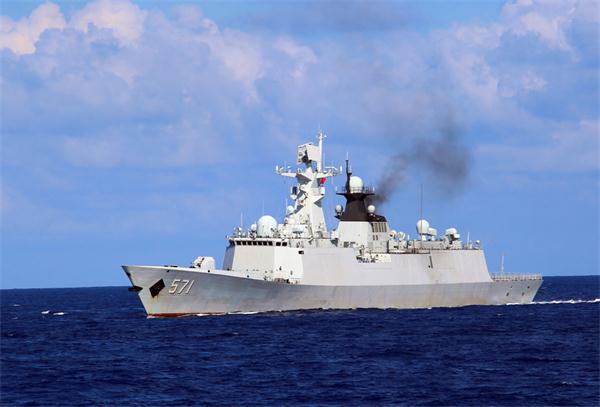
Missile frigate Yuncheng launches an anti-ship missile during a military exercise in the water area near South China's Hainan Island and Xisha islands, July 8, 2016. [Photo/Xinhua] |
The Philippines' arbitration case in the South China Sea dispute is a political farce enshrouded in a legal cloak. Its true purpose is to deny China's sovereignty and maritime interests.
When laws become political tools, their impartiality instantly disappears. On looking at the arbitral tribunal's actions it is impossible to escape the conclusion that the tribunal was acting as an agent of external powers.
A core appeal of the Philippines' case initiated by the government of former president Benigno Aquino III was to request the arbitral tribunal rule that China's historic rights in the South China Sea violate the United Nations Convention on the Law of the Sea, and deny China's Nine-Dash Line and maritime rights in the region.
To serve the external powers' needs, the tribunal ignored the rules of customary international law. China's historic rights in the South China Sea according to general international law were formed before the birth of the convention itself.
International experience shows the historic rights that evolve along with long-term practices are diverse and complicated. That's why the convention does not have unified rules on historic rights, and does not say its rules can replace historic rights. On the contrary, the convention leaves historic rights to the jurisdiction of general international laws, and shows its respect to historic rights in many places in the convention.
For instance, Article 298 of the convention excludes "historic ownership" from the convention's compulsory jurisdiction. The arbitration tribunal forcibly included historic rights in the convention's explanation and application. Thus the tribunal has actually gone beyond the convention's judgment authorization.
That's why the tribunal only ambiguously recognized the Philippines' appeal constitutes a dispute that is applicable or explainable according to the convention, without clarifying which articles of the convention are relevant.
The other core requirement of the Aquino III administration in its appeal was to request the tribunal should give a ruling on the legal status of some islands and reefs in the Nansha Islands.
The arbitration tribunal knows it has no jurisdiction to handle a dispute over land sovereignty. Yet, to pervert the law for its final predetermined award, the tribunal was selectively blind to the true intention of the Philippines, which is to deny China's sovereignty. That intention is clear, the foreign affairs ministry of the Philippines issued a document the same day it initiated the arbitration procedure, clearly announcing that the case was initiated to "protect our country's land and sea". It is obvious the case concerns sovereignty and therefore is not subject to the convention.
The arbitral tribunal intentionally ignored the issue of sovereignty, and expanded its power beyond its legal rights to judge the legal status of the islands and reefs of the Nansha Islands, intentionally breaking up the geographical whole of the Nansha Islands into separate islands and reefs.
Some arbitrators' points of view on the islands and reefs' legal status and maritime demarcation in this case were totally opposite to their long-term views. Their "self-betrayal" obviously cannot be explained from an academic or theoretical angle. Thus there are reasons to doubt their legal conscience and the impartiality of the tribunal.
Meanwhile, the whole process of the arbitral tribunal completely drifted away from the principle of procedural justice.
The Chinese Society of International Law and many other academic agencies questioned and criticized the procedure of the tribunal in this regard. Rather than evaluating the merits of the argument to reach its conclusion, the tribunal had a preset conclusion that it "proved".
While quoting similar international arbitration cases, the arbitrators intentionally avoided the general practices established by the majority of cases, and only quoted the minority of cases that were useful to them in supporting their predetermined conclusion.
And while confirming facts, the tribunal turned a blind eye to the facts favorable to China, or deliberately belittled their weight. In the process of admitting evidence, the tribunal neglected the authenticity, relevance and probative force of the evidence, and uncritically accepted evidence that supported the Philippines' stance.
The value of international jurisdiction and arbitration lies in impartiality and objectivity. As a public tool for justice, arbitration tribunals should not take sides or they will become a private tool of one contending party. That's exactly how the South China Sea arbitral tribunal has behaved in this case.
The article first appeared in People's Daily on Wednesday.


Copyright 1995 - . All rights reserved. The content (including but not limited to text, photo, multimedia information, etc) published in this site belongs to China Daily Information Co (CDIC). Without written authorization from CDIC, such content shall not be republished or used in any form. Note: Browsers with 1024*768 or higher resolution are suggested for this site.
License for publishing multimedia online 0108263 Registration Number: 130349