 |
|
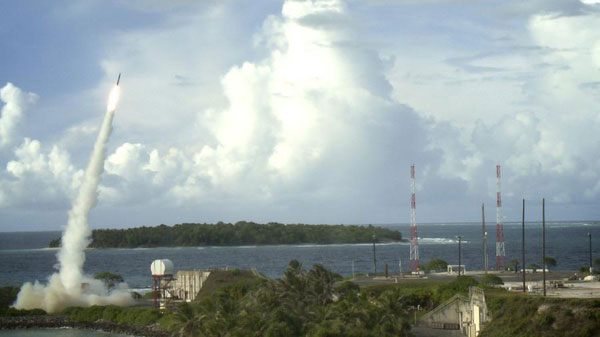
A Terminal High Altitude Area Defense (THAAD) interceptor is launched during a successful intercept test, in this undated handout photo provided by the US Department of Defense, Missile Defense Agency. [Photo/Agencies] |
It is worrisome that the Republic of Korea has agreed to deploy the US' Terminal High-Altitude Area Defense system on its soil despite the opposition from China and Russia. If the ROK ignores its neighbors' concerns and implements its agreement with the United States, what would be the consequences?
First, the ROK might lose a diplomatic leverage to negotiate with China on the Democratic People's Republic of Korea's nuclear issue. THAAD may facilitate the formation a US-ROK-Japan military bloc, which would affect China and Russia adversely and inadvertently make the situation advantageous for the DPRK, because Beijing and Moscow will lose the incentive to control Pyongyang's dangerous behaviors. In short, THAAD will cost the ROK an important diplomatic weapon in return for a military weapon.
After Park Geun-hye was elected ROK president, Seoul and Beijing seemed willing to transform bilateral relations into a more mature partnership. Economic relations between the two countries, including trade and investments, have developed faster than political ties. It is a pity therefore that instead of improving, bilateral political relations will suffer a blow because of THAAD. And some people in the ROK fear this could affect economic exchanges in the future.
Second, tensions on the Korean Peninsula will escalate, making the already volatile situation further insecure. To defuse the tensions and maintain stability on the peninsula, the ROK should establish a regular communication channel with the DPRK and strike the right balance between the US and China, especially when there is a conflict of interests between the two countries.
Initially, the Park administration seemed to be moving in this direction. But now the communication channels with the DPRK are closed, even the sole joint economic project, Kaesung Industrial Complex, has been shut down.
Increasing a state's military capacity does not necessarily bring about peace. Instead, it could lead to an arms race. This is called the "security dilemma", an ironic situation in which military tensions rise as rivals stock more weapons. This could be what the Korean Peninsula is looking at.
Although the ROK has emphasized that THAAD is strictly for its defense purposes against the DPRK's missiles, no one believes it. THAAD goes beyond the Korean Peninsula issue, and it will heighten tensions between the US and China in East Asia.
Third, the operational control of the ROK military is likely to be further subjected to US command. The ROK Ministry of Defense had plans to build "Kill Chain" and Korean Air and Missile Defense before it suddenly decided to deploy THAAD. And if THAAD is solely for the ROK's defense, then it does not make sense for the US to pay for it, as has been reported. Republican presidential candidate Donald Trump has already termed the ROK a "free-rider" on the US defense coach, although that is a ludicrous assumption.
Seoul's policy toward Pyongyang is highly likely to be dependent on Washington. And once THAAD is deployed, any chance of talks between Seoul and Pyongyang will disappear. Is this really in the interest of Seoul?
Fourth, THAAD will make it even more difficult to peacefully resolve the DPRK nuclear issue and, instead, intensify the arms race between Seoul and Pyongyang. Perhaps Seoul sees THAAD as deterrence to Pyongyang, but it may not work out that way. On the contrary, it could prompt the DPRK to intensify its nuclear weapons' program.
THAAD will also make the Korean Peninsula the last remnant of the Cold War. Ironically, what brought the Cold War to an end was not intensive stockpiling of nuclear weapons, but détente and diplomatic conciliation. The ROK must use diplomatic maneuvers with the DPRK and other neighbors to establish a diplomatic network dedicated to maintaining stability and peace in the region. For that, however, abandoning the Cold War mindset and reviewing the THAAD decision are necessary.
The author is a professor in the Department of Political Science and Diplomacy at Pusan National University, the Republic of Korea.


Copyright 1995 - . All rights reserved. The content (including but not limited to text, photo, multimedia information, etc) published in this site belongs to China Daily Information Co (CDIC). Without written authorization from CDIC, such content shall not be republished or used in any form. Note: Browsers with 1024*768 or higher resolution are suggested for this site.
License for publishing multimedia online 0108263 Registration Number: 130349