 |
|
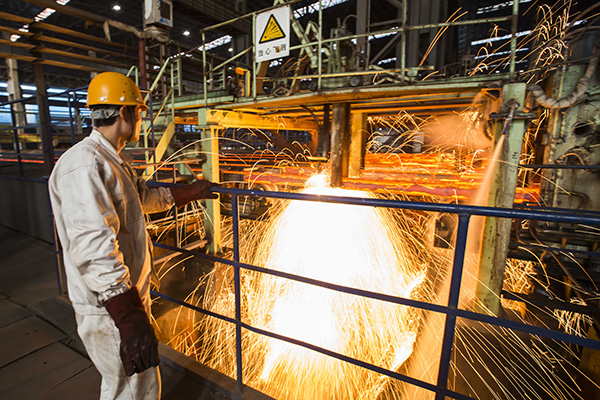
A worker at a steel company in Lianyungang, Jiangsu province, in Jan 2015.[Photo/China Daily] |
The government vowed on Tuesday to accelerate efforts to reduce excess production capacity, a task that tops the central economic agenda. This is not the first time the central authorities have expressed their resolve to press ahead with the formidable task.
Still, policymakers should draw from the past lessons of corporate restructuring to ensure that reducing the overcapacity will not produce undesired side-effects as before.
Xia Nong, a senior official with the National Development and Reform Commission, China's top market regulator, said in the steel sector, 47 percent of the targeted excess capacity has been reduced and the pace will be accelerated in the coming months. It indicates that the capacity-cutting pressure has become heavier, triggering rising concerns that the government may fail to accomplish one of the key tasks it has set for this year.
Such concerns are understandable, but unfounded. The real concern is not whether the task will be accomplished, but how it will be achieved.
This is not the first time the country has attempted to reduce excess production capacity. At the start of this century, China made a similar move because of the serious over-supply in sectors such as cement, steel and aluminum.
However, after the onset of the 2008 global financial crisis, China launched a massive stimulus package to anchor the economy. Although it played a decisive role in stabilizing growth, much of the stimulus went to fixed assets and construction. China's steel and cement production increased dramatically in the following years as the burgeoning economy drove up demand for relevant products and, in response to that surging demand, the local governments encouraged more production.
The severity of the challenge now facing China's policymakers in cutting excess capacity is, in a sense, rooted in the past failure to appropriately handle the problem.
Why did policymakers fail to solve that problem? A major reason is, China remains a mixed economy, with governments playing an important role in making and implementing economic development plans. Many major corporate restructurings are actually encouraged by government officials, who, with a view to expanding the local GDP and improving their personal performance records, make decisions that do not necessarily suit the economic situation, leading to financial woes for the concerned enterprises.
A solution to this problem is for the central government to deepen market reforms. China's top leaders have on many occasions stated their intention to make the market play the "decisive" role in allocation of economic resources. To accomplish this, market forces should be better respected in deciding corporate mergers and acquisitions and the government's role should be to ensure competition-friendly market order.
To fully bring out the role of the market, a consensus needs to be reached among local policymakers that they must allow the market to play a larger role in the current initiative to reduce excess capacities. It may take less time to achieve the capacity reduction targets through administrative orders, but cutting excess capacity in this way will produce side-effects that will only bring more trouble in the future.
Given the paramount importance of excess capacity reduction in China's overall economic restructuring, it is worthy of taking more time to push the initiative in a more balanced and market-oriented manner so that there would be fewer shocks not only to the job market but to the long-term sustainability of corporate management.
The author is a senior writer with China Daily. xinzhiming@chinadaily.com.cn


In our daily life, more and more loanwords appear and change our habits in Chinese expression. Loanwords sound very similar with their original English words, and the process of learning them is full of fun to foreign students.

It has been a while since I've contributed to this Forum and I figured that since now I am officially on summer holiday and another school year is behind me I would share a post with you.
Copyright 1995 - . All rights reserved. The content (including but not limited to text, photo, multimedia information, etc) published in this site belongs to China Daily Information Co (CDIC). Without written authorization from CDIC, such content shall not be republished or used in any form. Note: Browsers with 1024*768 or higher resolution are suggested for this site.
License for publishing multimedia online 0108263 Registration Number: 130349