 |
|
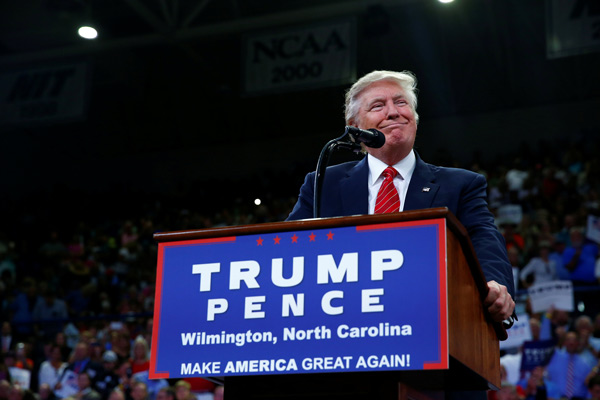
Republican US presidential nominee Donald Trump speaks to the Trask Coliseum at University of North Carolina in Wilmington, North Carolina, US, August 9, 2016. [Photo/Agencies] |
US Republican presidential nominee Donald Trump on Tuesday played the China-bashing card once again in his latest attempt to reverse his falling popularity. The inflammatory rhetoric, however, is dangerous and damaging to relations with China.
In a speech in Detroit that outlined his economic prescription for the United States' economic headaches, Trump alleged that China "breaks the rules in every way imaginable" when trading with the United States, and "is responsible for nearly half of our entire trade deficit".
The former property developer pledged to boost the US economy by hindering China's exports to the US market and renegotiating global trade rules. "Americanism not globalism will be our new credo," Trump said.
To make Trump more appealing to the blue-collar working class in Midwestern states, the economic advisers of the New York mogul earlier threatened a tougher approach on trade that includes a possible "trade war" with China, the world's second-largest economy and the US' largest trading partner.
By making China and global free trade the scapegoat for the US' lackluster economic performance, Trump and his team betrayed the Republicans' traditional endorsement of unrestricted trade. It is no coincidence that Trump shares a similar view with his Democratic rival Hillary Clinton that Washington should pursue myopic protectionism and "stand up to China" to make up for lost ground.
For years, China-bashing has been an easy card for US presidential candidates to play to cover up the country's fundamental structural drawbacks. After all, rectifying these problems needs more painstaking reforms that neither of the two parties dare propose at the risk of electoral defeat.
However, the populist protectionist policies mean Americans would have to pay a much higher price to bring factory jobs back to the country. By failing to focus on some real competitive edges, such protectionist means will only prompt countermeasures from other nations, leading to tit-for-tat protectionism and even trade wars, in the worst-case scenario.
The US Chamber of Commerce, traditionally a supporter of the Republicans on trade, said that Trump's approach would cost 3.5 million US jobs and result in higher prices for American consumers as well as a weaker economy.
Meanwhile, lashing out at China for US economic frustrations has proven futile. Ironically, the US middle and working classes, whom Trump and Clinton have been eager to pander to, would become the first to take the hit of US trade barriers against China.
As the main beneficiary of Sino-US win-win cooperation, Americans have grown accustomed to high-quality and affordable Chinese-made goods. Without their country's massive trade with China, neither their quality of life nor their country's high-end advantage in the global industrial chain can be maintained.
Fiery rhetoric has become Trump's calling card ever since the start of this election race. But even the billionaire himself would not have seen his own business thrive without decades of ties with China.
The world has gotten used to generations of US presidential candidates denouncing China in an election race. But they usually reorient their China policy as soon as they enter office and tried instead to bolster ties.
That was true with former presidents George W. Bush and Hillary's once anti-trade husband Bill Clinton, who nevertheless gave China most-favored-nation treatment, which in part contributed to the US' economic boom in the 1990s.
Hopefully, the threat of launching a trade war with China by the current presidential candidates is merely tough talk. China-bashing is a recurring theme every four years, and by now it's become quite monotonous. Let's hope four years from now the presidential hopefuls are willing to change their tune and say something more truthful about the US' relationship with China. US voters deserve it.


In our daily life, more and more loanwords appear and change our habits in Chinese expression. Loanwords sound very similar with their original English words, and the process of learning them is full of fun to foreign students.

It has been a while since I've contributed to this Forum and I figured that since now I am officially on summer holiday and another school year is behind me I would share a post with you.
Copyright 1995 - . All rights reserved. The content (including but not limited to text, photo, multimedia information, etc) published in this site belongs to China Daily Information Co (CDIC). Without written authorization from CDIC, such content shall not be republished or used in any form. Note: Browsers with 1024*768 or higher resolution are suggested for this site.
License for publishing multimedia online 0108263 Registration Number: 130349