 |
|
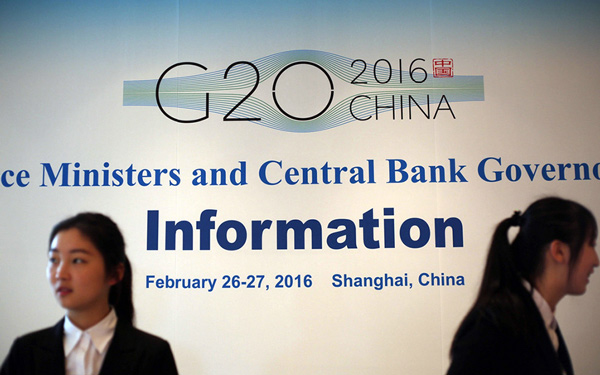
Staff work at the information desk for the 2016 G20 Finance Ministers and Central Bank Governors Meeting at the Pudong Shangri-La East Shanghai hotel in Shanghai, Feb 24. [Photo/IC] |
The theme of the 11th G20 Leaders' Summit, "building an innovative, invigorated, interconnected and inclusive world economy", will help China better play its role in world economic development as well as encourage it to promote its innovative mechanism to deepen the interconnectivity of and boost the global economy. China has been the main driver of world economic growth but as the host of the G20 summit-scheduled for Sept 4-5 in Hangzhou, East China's Zhejiang province-its global role has acquired greater importance because of the global economic slowdown and dwindling trade, and developed countries, including the United States, inability to use innovation to tide over the economic problems.
But deepening the interconnectivity of the global economy is a job easier said than done. G20 economies, both developed and developing, have their own policies and interests, which are sometimes difficult to coordinate. On one hand, developed countries try to pressure developing economies into further opening their domestic markets as well as take advantage of their capital to sway the latter's economic trend. On the other hand, while introducing foreign capital and technologies, developing countries are worried about the developed world's capital monopoly and technological control and thus tend to set certain restrictions.
Some developed countries have gone all out to sabotage established free trade rules and resorted to trade protectionism. Such practices are essentially aimed at creating a new regime of unfair trade for developing countries and replace essential unfairness with superficial fairness.
Developing countries are comparatively weak in capital and technological advancement; their only advantages are cheap labor, low environmental protection costs and relatively open intellectual property rights. But it is exactly in those areas that developed countries try to force the developing economies to raise their costs, and pressure them to import genetically modified (GM) foods, while turning a blind eye to their low-level health conditions and administrative management. In so doing, developed countries ignore the fact that ordinary people in developing countries have little knowledge of GM foods and that their administrative and commodity management is still at a relatively low level, and thus endanger their national safety and interests.
The developed world usually tends to protect its labor market and impose anti-dumping and anti-subsidy sanctions on the developing countries making it even more difficult for them to export their products. For example, the European Parliament declines to recognize China as a market economy even though that is in violation of the agreements the European Union reached with China when it joined the World Trade Organization. This practice has hurt China's exports to the EU and seriously compromised the "spirit of contract" deep-rooted in world trade.
The Hangzhou G20 summit should pay attention to all these problems and try to expand the common ground by resolving the developed and developing countries' differences and deepening the interconnectivity of the world economy.
The term "inclusive" is part of the Hangzhou summit's theme. And countries, developed or developing, big or small, can work together and promote mutual cooperation only if they have an inclusive approach. An inclusive approach will also help them to make more friends than enemies. Such an approach is not only essential for global economic cooperation, but should also become a top principle for diplomacy.
Compared with a realistic and tit-for-tat approach usually seen in Western cultures, Chinese culture has celebrated the "spirit of inclusiveness" since ancient times. So, how to make the developed countries in G20 embrace this spirit and help them realize the quintessence of China's traditional culture can be of vital importance to the success of the Hangzhou summit and maintenance of world peace. As a responsible power and the host country, China should brave all difficulties to undertake this responsibility.
The author is a professor of Japan studies at China Foreign Affairs University.

Copyright 1995 - . All rights reserved. The content (including but not limited to text, photo, multimedia information, etc) published in this site belongs to China Daily Information Co (CDIC). Without written authorization from CDIC, such content shall not be republished or used in any form. Note: Browsers with 1024*768 or higher resolution are suggested for this site.
License for publishing multimedia online 0108263 Registration Number: 130349