 |
|
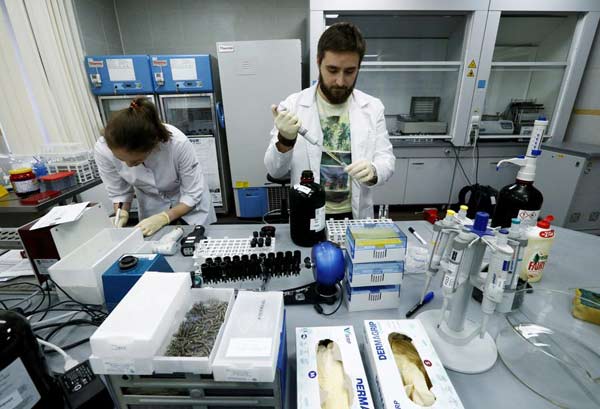
Technicians Ilya Podolsky and Natalia Bochkaryova work at the Russian anti-doping laboratory in Moscow, Russia, May 24, 2016. [Photo/Agencies] |
Elite sports and doping have long been deeply interlinked. Reaching an elite level in sports requires a tremendous amount of hard work, dedication and focus. By definition, few succeed, but those who do may enjoy great personal and financial rewards. Using performance-enhancing substances can seem like an easy way to boost one’s chances of reaching — or remaining at — that top level.
Doping in sports has most likely been going on for centuries. But the successful isolation of androgenic anabolic steroids brought a surge in the practice in the 1930s. The effects on performance can be seen in the extraordinary results of East German athletes in the 1970s and 1980s, some of whose records have yet to be broken. But the drawbacks of anabolic steroids were no less obvious: those same athletes often experienced infertility, cardiovascular problems, tumors and other adverse effects.
After a doping test for these steroids became mandatory in 1975, numerous athletes have been caught and sanctioned. Yet these substances remain the most commonly abused in elite sports.
Another common doping substance is recombinant erythropoietin (EPO), a protein that increases endurance by stimulating production of oxygen-carrying red blood cells. The downside is increased risk of stroke and myocardial infarction. In one of the greatest doping scandals of the 21st century, Lance Armstrong, seven-time Tour de France winner, was found to have used it after years of denial. Some athletes also resort to so-called blood doping — transfusions of oxygenated blood before an event, which achieves a similar result as EPO.
Since its establishment in 1999, World Anti-Doping Agency has been leading the charge to curb doping by improving detection and testing. Researchers have continually developed new, more accurate methods for detecting a wider variety of substances.
One recent innovation is a testing method that detects long-term metabolites left behind by anabolic steroids. Re-analysis of test samples from the 2008 and 2012 Olympic Games using these techniques shows up to 8 percent were positive for doping, compared with the 1 percent previously detected. To maximize the impact of this technology, doping tests are now required more frequently, not only during competitions, but also between them.
But just as the technology for detecting substances improves, new methods of artificial performance enhancement emerge. In particular, the rise of gene therapy has raised the possibility of introducing genes or genetically modified cells into the body to boost athletic performance.
Clinical trials are ongoing for several genes of interest for enhancing athletic performance, including EPO. Experience suggests that the many known and unknown risks associated with gene therapy will do little to deter its use for doping purposes.
With “gene doping” close to becoming a reality, WADA is already working to counter it. Gene doping has been prohibited since 2003, and the first detection method, based on EPO’s gene sequence, was implemented this year.
The key to that method is distinguishing between normal genes, which contain both coding and non-coding elements, and artificial genes, which contain only the coding elements. DNA without non-coding elements that has leaked into plasma is evidence of gene doping. Other potential detection methods, likely to be implemented in the near future, could identify traces of the viral vector or detect activating substances used to enhance activity of the newly introduced gene.
The battle against doping in elite sports can sometimes feel interminable. Advances in detection, however impressive, seem to be continually outpaced by innovations in doping. But giving up is not an option. Doping deeply undermines the integrity of elite sports, which are supposed to be a demonstration of what the human body can achieve — not how far extreme pharmaceutical manipulation of the human body can take us.
The author is a researcher at Karolinska Institute in Solna, Sweden.
Project Syndicate

 Brexit tells world to change path of globalization

Copyright 1995 - . All rights reserved. The content (including but not limited to text, photo, multimedia information, etc) published in this site belongs to China Daily Information Co (CDIC). Without written authorization from CDIC, such content shall not be republished or used in any form. Note: Browsers with 1024*768 or higher resolution are suggested for this site.
License for publishing multimedia online 0108263 Registration Number: 130349