 |
|
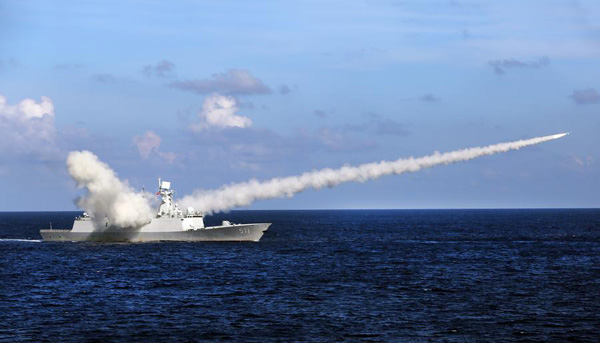
Missile frigate Yuncheng launches an anti-ship missile during a military exercise in the water area near South China's Hainan Island and Xisha islands, July 8, 2016. [Photo/Xinhua] |
News of the Sino-Russian joint exercise, Joint-Sea 2016, in the South China Sea in September is apparently irritating to the Commander of the US Pacific Fleet Admiral Scott Swift, who, despite visiting China in early August, described the joint drill as an action "not increasing the stability within the region" but "could have been conducted" in other places.
Russia's involvement in the South China Sea is not something the United States is happy about. A China-Russia exercise could easily dwarf the joint exercise of the US and the Philippines. It will also show China is not standing alone after the ruling of the arbitral tribunal. It also contrasts with the US' failed bid to call on Japan, Australia and India to join its patrols in the South China Sea.
China has held joint exercises with both Russia and the US, but those exercises were fundamentally different in purpose. The Sino-Russian exercise this September reflects the strategic partnership between the two nations which is not, but next only to, an alliance. Both countries have criticized the deployment of the Terminal High-Altitude Area Defense anti-missile system in the Republic of Korea. They believe the move would destabilize the strategic equilibrium on the Korean Peninsula and damage China's and Russia's strategic security. Recent years also found the drills extended to previously uncharted waters in the Mediterranean and the Sea of Japan. The scenarios became increasingly sophisticated and were not confined to tactical level. Last May the two countries also held a joint computer-assisted anti-missile drill.
This is in sharp contrast to the subdued military exercises between China and the US which are restricted to "non-sensitive" humanitarian areas such as humanitarian aid and disaster relief, and anti-piracy and rescue missions at sea. Both sides have made painstaking efforts to explore new areas, but there is a glass ceiling for further cooperation. Since 2000 the US Congress has forbidden exchanges between the US military and China's People's Liberation Army in 12 operational areas because the PLA could learn too much from such exchanges and "create a national security risk".
If the greatest challenge to China-US relationship is trust, then the top priority for the two militaries is crisis management. Many accidents or near accidents have occurred, such as the Chinese and US aircraft collision in 2001, the standoff between USNS Impeccable and USS Cowpens on one side and Chinese ships on the other in 2009 and 2013, and the deadly close encounter between a Chinese J-11B fighter jet with a USN P-8 in 2014. The accidents or near accidents occurred in China's exclusive economic zones. But given the PLA's increasing involvement overseas, the possibility of unplanned meeting between Chinese and the US military vessels or aircraft has increased.
That is why confidence building measures such as Code for Unplanned Encounters at Sea and the Rules of Behavior for Safety of Maritime and Air Encounter between China and the US are important. CUES, for example, provides a set of communication and operational procedures to avoid a ship getting too close to any vessels in formation; avoid aiming guns, missiles, and fire control radars in the direction of vessels or aircraft encountered. They can help avoid miscalculations and misjudgments.
Can China and the US conduct joint exercises on CUES and Rule of Behavior in the South China Sea? The Chinese and US navies practiced CUES during two Rim of the Pacific Exercises in the waters off Hawaii. But it is the waters of the South China Sea that is most volatile. And China is more determined to safeguard its sovereignty after the arbitral ruling that Beijing rejected.
The US has vowed to continue flying and sailing in the South China Sea in the name of "freedom of navigation". But despite China and the US being at loggerheads, it is in the interest of both countries to avoid accidents, let alone a conflict, in the future. A manageable relationship between the two giants is also an assurance for littoral states in the region, because "the grass will suffer, if the elephants fight".
The author is an honorary fellow at the Center on China-American Defense Relations, Academy of Military Science.

Copyright 1995 - . All rights reserved. The content (including but not limited to text, photo, multimedia information, etc) published in this site belongs to China Daily Information Co (CDIC). Without written authorization from CDIC, such content shall not be republished or used in any form. Note: Browsers with 1024*768 or higher resolution are suggested for this site.
License for publishing multimedia online 0108263 Registration Number: 130349