 |
|
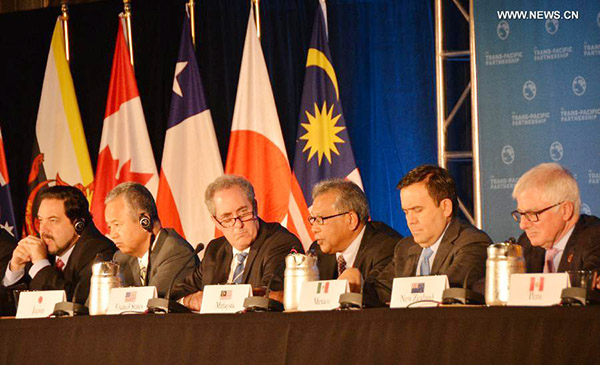
Trade ministers of the United States and 11 other Pacific Rim countries attend a press conference after negotiating the Trans-Pacific Partnership (TPP) trade agreement in Atlanta, the United States, on Oct. 5, 2015. [Photo/Xinhua] |
The prospects for the passage of the US-led 12-nation Trans-Pacific Partnership agreement by the US Congress look bleak. Both US presidential candidates, Hillary Clinton and Donald Trump, are critical of the TPP. Although US President Barack Obama will try hard to get the TPP ratified before leaving office, the current anti-trade political sentiment in the United States makes the task extremely difficult for the Obama administration.
If the Congress does not pass the TPP during Obama's term, the next US president will have to take it to the Congress. And no matter who the next president is, he/she is likely to propose major revisions to the current TPP agreement. But revising and renegotiating the agreement will be very difficult. The other TPP members are unlikely to agree to renegotiation as they have already worked on achieving domestic political consensus before agreeing to the TPP. Further renegotiation on any issue prompted by shifts in US interests would create new political challenges for other TPP members. As a result, the TPP may get stalled indefinitely.
The failure of the TPP will have several implications. The agreement was widely promoted as a 21st century gold-standard trade agreement. It is probably the most exhaustive trade agreement drafted so far with more than 5,000 pages and 30 chapters. It includes many issues that are hardly discussed at the World Trade Organization and are absent from most bilateral and regional free trade agreements such as labor and environmental standards, government procurement rules, e-commerce and investor-state dispute settlement.
By making domestic regulations of member countries as identical as possible for ensuring free movement of goods, services, capital and people within the TPP group, the agreement is aimed at setting new standards for global trade governance. The failure to implement such an agreement would imply the lack of success of trade policymakers to convince all stakeholders about the benefits of a high-class trade agreement. It would also mean a global setback for free trade, because protectionist propagators opposing the TPP would succeed in their objective. This might result in similar protectionist views affecting other trade agreements being negotiated elsewhere in the world.
Along with the TPP, another major trade agreement-the Transatlantic Trade and Investment Partnership being negotiated by the US and the European Union-h(huán)as also run into problems. The TTIP talks appear to have failed with the US and EU being unable to agree on several issues. The failure of the TTIP and TPP, both led by the US, is a major blot on the US' ability to provide leadership to global trade. For several years, the US has been paying less attention to the WTO and devoting more energy to pushing trade liberalization through mega-trade agreements like the TPP and TTIP. It is not clear whether the lack of success with these agreements will prompt the US to return to the WTO with greater vigor for pushing an inclusive multilateral trade agenda.
The TPP would have significantly changed the regional economic architecture of the Asia-Pacific. Its failure might also affect the Regional Comprehensive Economic Partnership. The 16-member RCEP, apart from large emerging markets like China, India and Indonesia, which are not in the TPP, has several members common to the TPP from the Asia-Pacific. The stalling of the TPP would make the RCEP members much more cautious about pushing trade liberalization given the political backlashes such attempts might produce. This might result in the RCEP settling for uncontroversial and minimal liberalization, which would hardly make the agreement more meaningful than the trade deals that already exist in the region. And the region as a whole might also step back from implementing an aggressive agenda for free trade till the political outlook for trade improves.
The author is a senior research fellow and research lead (Trade and Economic Policy) at the Institute of South Asian Studies in the National University of Singapore.

Copyright 1995 - . All rights reserved. The content (including but not limited to text, photo, multimedia information, etc) published in this site belongs to China Daily Information Co (CDIC). Without written authorization from CDIC, such content shall not be republished or used in any form. Note: Browsers with 1024*768 or higher resolution are suggested for this site.
License for publishing multimedia online 0108263 Registration Number: 130349