 |
|
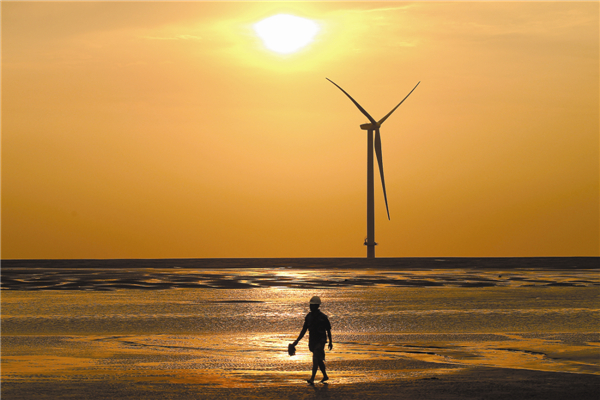
A wind farm at Rudong in Jiangsu province. China's installed wind power capacity had reached almost 63 million kilowatts by the end of 2012. [Photo by Xu Congjun / for China Daily] |
One year ago, leaders of 193 countries came together to commit to ending poverty, combatting climate change, and fighting injustice. They agreed a plan for the future of the world and its people. The plan—the 2030 Agenda for Sustainable Development, offers a better future for billions of people around the world and for our planet as a whole.
Turning its seventeen Sustainable Development Goals into reality before the 2030 target date will be one of the most ambitious undertakings the global community has ever taken. But I am confident that if people are at the centre of all actions, if the commitment of stakeholders is maintained and if the spirit of partnership prevails, there will be no shortage of success in the next fourteen years.
I am optimistic is because of the nature of the Sustainable Development Goals (SDGs). The Goals are underpinned by 4 powerful principles. First–they are connected and indivisible, linking development, human rights, peace and security. Second–they are universal. They apply to every person everywhere. Third–they are to be implemented through inclusive participation of all of society. Fourth – as they are implemented no-one should be left behind. The SDGs have created a common purpose for the well-being of coming generations and for a planet that is fit for the future. This is why we have seen a fast, strong, and even urgent shift from all sectors toward more sustainable practices and policies.
In this first year anniversary—"SDG Year 1" —more than 50 governments, and also numerous businesses, scientists and civil society organizations have stepped up their efforts to make the SDGs a central framework for their policies and actions, and have increased their focus and investment on data collection and analysis to guide decisions and leave no one behind.
At the local level, hundreds of cities and municipalities are adopting their own plans to achieve the goals. And thousands of communities from different sectors of society have accelerated actions under the SDG banner.
All these steps have built momentum to limiting climate change, advancing gender equality, mitigating natural disasters, addressing mass migration, and reducing inequality.
This past July, twenty-two governments presented to the United Nations their SDG plans. They showed how they have made the SDGs a central framework for national development. They help ensure that actions are aligned, that programmes work in synergy and that finance is used as efficiently as possible. This means that development cooperation will be aligned with the SDGs.
The momentum behind the Paris Agreement on Climate Change is also accelerating and so far governments of twenty-seven nations have ratified the agreement—including the world's largest emitters of greenhouses gases, China and the United States.
Other sectors are building momentum too. There has been a noticeable transformation in how businesses are done with greater focus on social, economic and environmental dimensions of development. And the UN has shifted to joint working in support of aligned policies from focusing on projects to convening stakeholders, and aligning efforts so that partners can work together in an efficient and effective manner.
It is clear that enormous strides have been made.
But much more has to be done to implement the SDG plan. The SDGs lay out specific targets for all to solve the challenges our planet and people around the world are facing.
How do we stay on this path and realize a sustainable future?
That is where the most important stakeholder—the people—comes in. Public support and public pressure will be essential for transforming the SDGs from aspiration into reality. My aim is for 2 billion people around the world to be aware of the SDGs by the end of 2017 and for another million people to become activists—to be change-agents who press decision-makers and who hold them accountable until we have transformed our world and made it more sustainable.
Children and youth have a particularly important role to play, as the face of social movements, the drivers of social change and the torchbearers of a more sustainable future for generations to come.
The first anniversary of the adoption of the SDGs is an opportunity to celebrate all achievements made, to do more to make SDGs a reality and most importantly to thank the governments, businesses, civil society groups and young people around the world for all their efforts.
If all the relevant stakeholders continue to work towards building a sustainable and resilient world, achieving the SDG targets in the next fourteen years and transforming the way we live really is a feasible objective.
And let’s face it- we really do not have a plan B. There is no planet B.
Dr. David Nabarro is Special Adviser to the Secretary General for the 2030 Agenda for Sustainable Development and Climate Change

Copyright 1995 - . All rights reserved. The content (including but not limited to text, photo, multimedia information, etc) published in this site belongs to China Daily Information Co (CDIC). Without written authorization from CDIC, such content shall not be republished or used in any form. Note: Browsers with 1024*768 or higher resolution are suggested for this site.
License for publishing multimedia online 0108263 Registration Number: 130349