 |
|
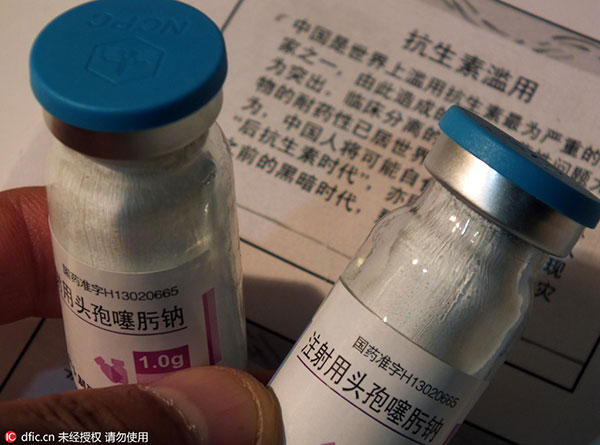
Antibiotics is shown in this photo taken on Oct 20, 2011 in Yichang, central China's Hubei province. [Photo/IC] |
For around 90 years, antibiotics have been the go-to medicine for many illnesses. However, their systematic misuse and overuse in human medicine and food production is making bacteria increasingly resistant to their effects. Resistance is also growing to drugs commonly used to combat viruses, fungi and other parasites. This phenomenon is called antimicrobial resistance (AMR).
Imagine common surgical procedures such as a caesarean section, or a simple bout of pneumonia suddenly becoming life threatening because we can't fight infections with antibiotics or other antimicrobial drugs-that's the situation we face if we don't act on AMR now.
Unless immediate action on a global scale is taken, the world is heading toward a post-antibiotic era in which common infections could once again kill. Resistance to antibiotics could be responsible for killing 10 million people every year across the world over the next 30 years. That's the equivalent to one person every 3 seconds-which is more deaths than cancer causes today. The impact on national economies will be equally staggering: during the same time frame, without action to tackle AMR, the global cumulative economic cost is projected to reach about $100 trillion.
Clearly we cannot afford to sit idle if we care about the future of our families and those of coming generations.
That is why the World Health Organization was especially pleased with the commitment shown by the G20 countries at their meeting in Hangzhou earlier this month to address the "threat to public health, growth and global economic stability" posed by AMR.
Now is the time to build on this momentum. This week, the United Nations General Assembly will hold a high-level meeting on AMR. That this is only the fourth time in its history that the General Assembly is holding such a meeting on a health issue is a further signal that global leaders recognize the catastrophic consequences of failing to tackle AMR. While this high-level meeting is a milestone, the true measure of its value will be what happens next. And this will require leadership and action.
I believe the global war on AMR cannot be won without China's leadership-and China is well and truly stepping up to the plate. Last month, China issued the National Action Plan to Contain Antimicrobial Resistance. And the strength of China's research and development industry also makes it well suited to act as the global leader in the development of new drugs and technologies.
China has a tremendous opportunity to serve as an example to the rest of the world by demonstrating how the same multi-sector collaboration that delivered its national action plan on AMR must be followed by multi-sector implementation.
As with many of today's problems there is no silver bullet. Given the multi-sectoral nature of AMR, action is needed on the part of human medicine (doctors, nurses, pharmacists, patients), animal medicine (vets, farmers, the food industry), the pharmaceutical industry and the general public. We must improve awareness and understanding of AMR: among those who prescribe and dispense antibiotics, but also amongst patients-for instance, awareness about taking antibiotics correctly. We need to reduce the incidence of infection-by getting people serious about washing their hands effectively, especially in hospitals. Washing hands can also prevent the spread of diseases from animals to humans. And we need to increase investment in new medicines, diagnostic tools, vaccines and other interventions.
That China is already doing many of these things shows that it is poised to lead the global fight on AMR. WHO hopes to see all countries build upon the momentum of the G20 Hangzhou Summit, and this week's High Level Meeting at the UN General Assembly, through the development of their own national action plans on AMR. And everyone, everywhere can and must do their bit-by taking simple steps such as not pressuring doctors to prescribe antibiotics, and using them carefully if they are required. We are standing at a turning point. Now is the time for decisive action. Future generations will look back and judge us for the action we take on this issue today.
The author is WHO representative in China.


Colombian coffee has a story that I admire and use in my lectures and the reasons are the ones listed above. Congratulations!


Copyright 1995 - . All rights reserved. The content (including but not limited to text, photo, multimedia information, etc) published in this site belongs to China Daily Information Co (CDIC). Without written authorization from CDIC, such content shall not be republished or used in any form. Note: Browsers with 1024*768 or higher resolution are suggested for this site.
License for publishing multimedia online 0108263 Registration Number: 130349