 |
|
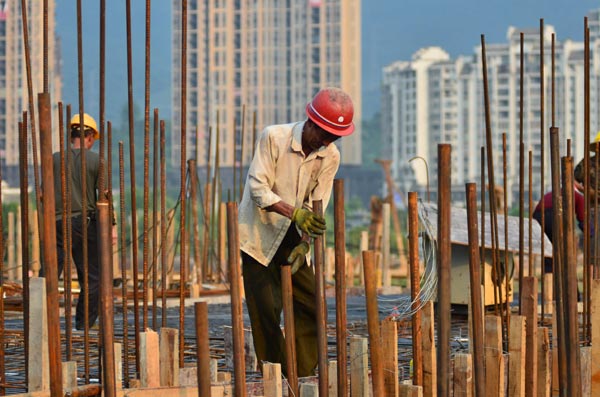
Workers at a property project in Chenzhou, Hunan province. Property developers are facing the pressure of a decline in net profits in the first half of 2014. [Photo/China Daily] |
Giving the poor access to financial services is accepted wisdom. What isn't appreciated is how this is undermined by a lingering lack of trust in banks among the people most in need of their services.
Many poor customers in Asia feel alienated and neglected by banks because financial solutions are usually not tailored to their needs, and when they are, they're often not clearly explained.
Financial exclusion can breed poverty traps and inequality, and delay the development of efficient financial markets. Fixing this is important for Asia, which, as the engine for 60 percent of global growth, will bear the burden of driving global prosperity for years to come.
An estimated 1 billion people in Asia don't have a bank account. Though savings rates are relatively high in Asian countries, 300 million people save outside the banking system through alternative savings channels, such as community savings and credit associations, which don't provide protections enjoyed by bank depositors if the institution fails.
Moreover, the poor are deterred by the cost and difficulty of opening and maintaining an account. The rural market is still seen by most financial institutions as high-risk, low return, as well as hard to reach.
Why are policies failing to help the poorest? And what more can be done?
I once met some illiterate widows in northern India who complained they had waited for months to open bank accounts to receive government compensation after their husbands had died. Complicated administrative processes and insensitive bank staff left them demoralized. The bank said it needed to comply with "know your customer" guidelines. But even after the paperwork was done, at least one of the widows didn't get any money; the checks had expired and nobody bothered to explain how to revalidate them.
Some tenant farmers in Pakistan once told me that they were encouraged to approach a local bank for loans, only to have their applications rejected despite providing land lease agreements as collateral. The hitch: the landowners already had outstanding borrowings guaranteed by the same parcel of land.
Sadly, most poor people still believe loans are for big farmers and businessmen. As a result, informal, often costly, credit sources thrive among the poor, even when financial institutions offer attractive lending schemes. High interest rates charged by informal moneylenders can cause mounting debt that can have tragic consequences, with many farmers seeing suicide as the only way out.
Digital financial services can help. Branchless banking channels such as debit cards and mobile phones can enhance coverage by giving recipients unique identifiers and placing the payment instrument in their hands.
But there are pitfalls here, too. People living in remote areas sometimes give their ATM cards and PINs to agents to withdraw their money for a fee-a clear security risk. Poor households also compromise their digital security by sharing mobile phones used for banking, which could expose them to fraud.
Financial literacy is the key to rebuilding trust in banking among the very poor.
Policies that empower women as educators of children on financial basics and as entrepreneurs themselves can help realize their untapped potential as financial inclusion enablers with enormous economic and social benefits. The remuneration of intermediaries dealing with poor women-and men for that matter-should be more closely tied to the financial well-being of their clients rather than how much product they sell.
New technology like biometric information and digital IDs has opened up exciting new channels for financial inclusion. But governments need to work closely with the private sector to improve internet connectivity for banking, as China has done through a massive program to boost rural broadband internet infrastructure.
Loopholes that allow insurers to deny valid claims and banks to wrongly refuse loans must be closed. Insurance claims for homes damaged in natural disasters are sometimes rejected because poor policy-holders didn't read or understand the fine print. China provides a possible corrective in its new national earthquake insurance program, which mandates minimum compensation levels for policy-holders.
And let's listen to the poor when drawing up policies to bring them into mainstream finance. That way, we won't end up creating more problems than we solve.
The author is principal financial sector specialist at ADB's Sustainable Development and Climate Change Department.


Colombian coffee has a story that I admire and use in my lectures and the reasons are the ones listed above. Congratulations!


Copyright 1995 - . All rights reserved. The content (including but not limited to text, photo, multimedia information, etc) published in this site belongs to China Daily Information Co (CDIC). Without written authorization from CDIC, such content shall not be republished or used in any form. Note: Browsers with 1024*768 or higher resolution are suggested for this site.
License for publishing multimedia online 0108263 Registration Number: 130349