 |
|
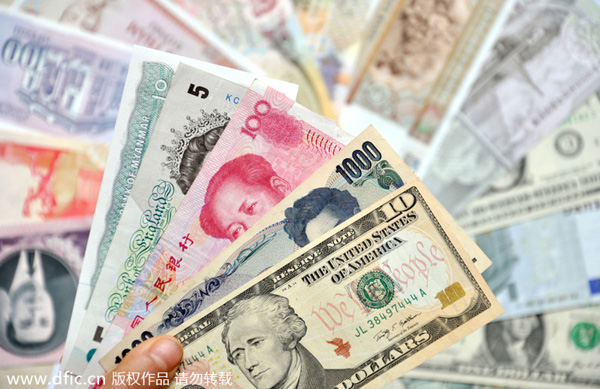
Foreign currencies are placed next to 100 yuan banknote. [Photo/IC] |
On Oct 1, the renminbi begins an exciting new chapter in its journey to becoming a global currency.
On that day, the Chinese currency will officially enter the Special Drawing Right (SDR) currency basket, joining the US dollar, the euro, the Japanese yen and the British pound in the elite “club” of global reserve currencies.
The IMF’s decision to admit the renminbi to this select grouping marks an important seal of approval, as it signifies that the renminbi is widely used and widely traded, even though it is still subject to some capital account restrictions. It also marks a significant moment for Hong Kong, which has played a key role in the renminbi’s internationalisation for more than a decade. After all, the city was the first offshore market to launch renminbi business in 2004, while the first offshore RMB-denominated bonds were issued in Hong Kong in 2007.
Now, a currency does not need to be part of the SDR basket to become a reserve currency. Similarly, SDR inclusion does not automatically translate into reserve-currency status. It is ultimately up to central banks to decide whether to hold assets denominated in a particular currency – and how much to hold.
What, then, is the significance of the renminbi joining the SDR basket, given that the SDR is not a currency and that few goods and services are priced in it?
First, it is a clear recognition of the renminbi’s development as a global medium of exchange. The “people’s currency” is now both widely used (ranked fifth by SWIFT, a network that banks around the world use to move money) and widely traded (ranked eighth by the Bank for International Settlements).
More importantly, admittance into the SDR basket serves as a harbinger: the renminbi’s role in the global arena will continue to expand across the board.
The renminbi’s current share of global payments is less than 2 percent, whereas the dollar and the euro together account for more than 70 percent. As companies and investors step up their use of the Chinese currency, this share will rise.
We also believe that by 2020 half of China’s trade will be settled in its own currency, up from 26 percent in 2015. Improved payment systems such as China’s Cross-Border International Payment System (CIPS) will help oil the wheels of this activity, while the IMF’s seal of approval should boost confidence that the renminbi is liquid and stable as a store of value.
Similarly, the renminbi’s share of global central bank reserves will also increase. At the moment, the dollar and the euro together account for nearly 85 percent of the world’s reserves, while the renminbi is not even recorded in the IMF’s regular surveys on central bank holdings. Come Oct 1, this will change: the renminbi will be separately identified in the IMF’s official reserves database, while the RMB proportion of central banks’ reserves will grow.
This is borne out by an HSBC survey conducted earlier this year of 77 central banks, which together manage more than half of the world’s reserves. Thirty-two respondents indicated that they already hold investments denominated in renminbi; this is up from three in 2012. The findings also showed that the renminbi’s share of global reserves will rise to 7 percent in 2020 and 10 percent by 2025. Moreover, the central banks polled indicated they may invest up to 6.7 percent of their reserves in the renminbi by 2025; this is up from 5.5 percent from a year earlier.
Meanwhile, the gradual liberalization of China’s capital account is opening up new ways that overseas investors – including central banks – can buy into a widening array of RMB-denominated assets.
Take the recently-announced Shenzhen-Hong Kong Stock Connect scheme. This expands the list of mainland-listed companies that overseas investors can trade in; it also widens the range of Hong Kong-listed stocks that mainland investors can buy and sell.
Another area of opening-up is China’s domestic bond market. It is already the world’s third-largest, after the US and Japan, and there is huge potential for growth. China has systemically rolled out measures that increase the level of foreign participation in its bond market, and last year, it once again allowed foreign entities to issue renminbi-denominated debt on the mainland.
In many ways, Oct 1, 2016, represents the culmination of more than a decade of change for what was once an almost exclusively domestic currency. But it is also the beginning of a new chapter: more change will come, as the renminbi moves steadily towards becoming a truly international currency that is used by companies, investors and individuals around the globe.
As the global hub for renminbi trade settlement, financing and asset management, Hong Kong has the expertise and capabilities to continue to play a pivotal role in this process.
The author is deputy chairman and chief executive of the Hongkong and Shanghai Banking Corporation Limited


Copyright 1995 - . All rights reserved. The content (including but not limited to text, photo, multimedia information, etc) published in this site belongs to China Daily Information Co (CDIC). Without written authorization from CDIC, such content shall not be republished or used in any form. Note: Browsers with 1024*768 or higher resolution are suggested for this site.
License for publishing multimedia online 0108263 Registration Number: 130349