 |
|
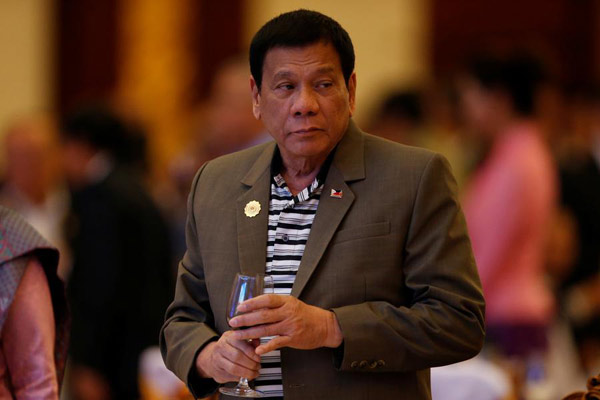
Philippine President Rodrigo Duterte attends a welcome dinner at the ASEAN Summit in Vientiane, Laos September 6, 2016. [Photo/Agencies] |
Philippine President Rodrigo Duterte's four-day state visit to China, scheduled to start on Tuesday, has drawn extensive attention from the international community since it was made public.
Duterte's government has made clear its priority is to improve domestic economic conditions and people's livelihoods, and it wants to take advantage of Beijing's Belt and Road Initiative to help realize these aims.
Duterte also wants to break the diplomatic impasse with China over the South China Sea created by former Philippine president Benigno Aquino III. From Jan 22, 2013 when the Aquino government unilaterally filed a case to an international tribunal on the Philippines' territorial dispute with China in the South China Sea to July 12 when the tribunal ruled on the case-which was actually beyond its jurisdiction-the Chinese government consistently made clear its "non-acceptance, non-participation and non-recognition" of the arbitration, which means the Philippines has not been able to gain substantial benefits from the arbitration.
At the same time, the signing of a joint statement between the foreign ministers of China and the Association of Southeast Asian Nations on July 25 aimed at fully fulfilling the Declaration on the Conduct of Parties in the South China Sea, along with the guideline on setting up a high-level hotline for maritime emergencies and the joint statement on rules in the event of accidental encounters in the South China Sea, passed by China and the bloc at a summit on Sept 7, also made the new Philippine government aware that the South China Sea issue is not the full picture of ASEAN's ties with China. Any obstinate confrontation with China, it believes, might cause the Philippines to lose some opportunities it might otherwise take advantage of, including China's booming outward investment.
Also, faced with changed international circumstances, the new Philippine government does not solely want to depend on the United States. So, it is no surprise that the Philippines has attempted to review its agreement signed with the US on strengthened defense cooperation and even demanded US troops withdraw from its territory. The words and actions of Duterte since being elected president indicate that the new government seems to be reconsidering the Philippines' previous diplomatic dependence on the US. However, the feasibility of this diplomatic approach remains to be seen. Prior to the establishment of a new government, the US will unlikely make a forcible response to the Philippines' policy change, theoretically leaving space for Manila to adjust its previous pro-US diplomatic policy.
Meanwhile, despite their divergences over the South China Sea, China and the US still engage in extensive cooperation, from UN peacekeeping missions and fighting terrorism to efforts to curb the proliferation of nuclear weapons and mitigate the effects of climate change, not to mention their economic collaboration and people-to-people exchanges. In particular, the two countries have maintained unblocked dialogue channels and strengthened security and maritime cooperation, such as a memorandum of understanding on mutually reporting their significant military actions and a MOU on how they behave at time of maritime and air encounters, both passed in November 2014. At the G20 Hangzhou Summit in early September, Beijing and Washington also reached consensuses on such issues as the establishment of a new pattern of big country relations, strengthening coastal guard and maritime cooperation and enhancing their interactions and security cooperation in the Asia-Pacific region.
The Philippines has also shown its intention to strengthen ties with Japan in an attempt to strike a diplomatic balance and acquire more interests. Japan's unconcealed attempt to contain China's further development also leaves more space for Manila to pursue closer political, diplomatic, security and economic ties with Tokyo.
Duterte's visit to China does not constitute a part of the alleged struggle between Beijing and Washington for Manila. A better China-Philippine relationship is essentially beneficial to the whole Asia-Pacific region. For the sake of regional peace and stability, the US should support Beijing and Manila normalizing their ties.
The author is director of the China Ocean Strategy Studies Center at the Shanghai Academy of Social Sciences.


Copyright 1995 - . All rights reserved. The content (including but not limited to text, photo, multimedia information, etc) published in this site belongs to China Daily Information Co (CDIC). Without written authorization from CDIC, such content shall not be republished or used in any form. Note: Browsers with 1024*768 or higher resolution are suggested for this site.
License for publishing multimedia online 0108263 Registration Number: 130349