Duterte's visit has ushered in a new era
 |
|
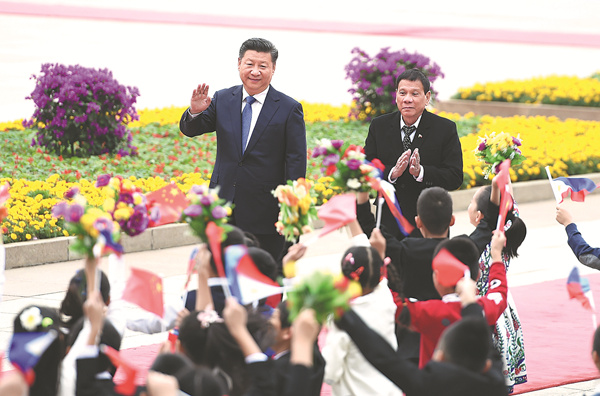
President Xi Jinping holds a welcoming ceremony to greet Philippine President Rodrigo Duterte in Beijing, October 20, 2016. Xie Huanchi / Xinhua |
During his four-day state visit to China last week, and his first to a country outside the Association of Southeast Asian Nations, Philippine President Rodrigo Duterte proved to be more than a man of his words.
His acerbic remarks on the Manila-Washington alliance apart, Duterte made genuine efforts during his visit to China to put Beijing-Manila ties back on track after his predecessor Benigno Aquino III soured the relationship between China and the Philippines by blatantly siding with the United States to initiate arbitral proceedings against Beijing over their maritime dispute in the South China Sea.
Interactions between Chinese and Philippine leaderships, for starters, are likely to resume after Duterte's visit to China, when he and his host President Xi Jinping witnessed the signing of many a cooperation deal. Duterte's visit should help the two sides restore the damaged mutual trust and revitalize their cooperation in infrastructure building, and combating drug trafficking and terrorism.
In particular, the two countries pledged to resolve their dispute in the South China Sea through consultations and negotiations by the directly concerned sovereign states, according to a joint statement issued on Friday. In this context, Duterte, unlike his predecessor, is expected to adopt a more independent, flexible and comprehensive foreign policy to strike a balance between major regional powers.
However, it is impossible for Duterte to seek full "separation" from the US, even though he is unhappy with the Philippines' long-time ally. Take the Philippines' military dependence on the US for example. Most of the weapons used by the Philippine military are supplied by the US and many military personnel have been trained in the US. That Duterte hinted at forging a new "alliance" with China and Russia and buying weapons from the two countries was more like emotional talk rather than a warning to the overreaching US.
Given the close economic ties between Washington and Manila, a breakup between the allies seem unlikely. As of 2015, the US had more direct investment in the Philippines than any other country; and at least 30 percent of the 10 million Philippine expatriates work in the US.
The joint statement by Beijing and Manila does avoid any mention of the South China Sea arbitration case initiated by the former Philippine government against China, but that does not mean their territorial dispute is settled. The Philippines is unwilling to make compromises and needs the US to endorse its claims. And although Washington has basically stayed calm in the face of "dramatically" improving Beijing-Manila relations, which can reduce the possibility of the US rooting for its Asian ally in the South China Sea issue, it is unlikely to sit idle while the ties between Beijing and Manila improve.
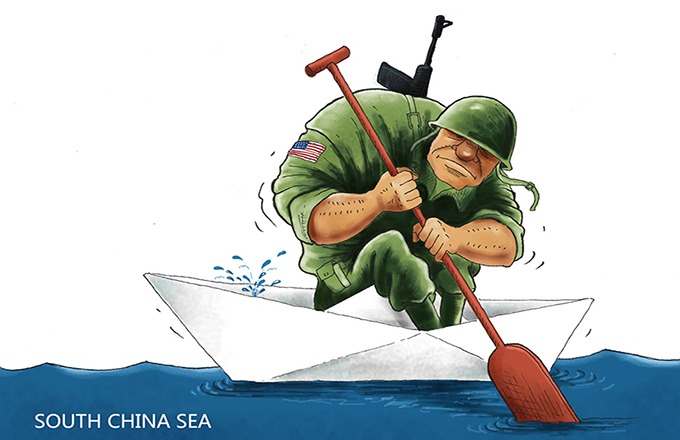
The USS Decatur's intrusion into China's territorial waters near Xisha Islands on the last day of Duterte's China visit sent a signal to the international community that Washington will continue to intervene in the South China Sea issue on the pretext of protecting "navigational freedom" despite the improvement in the Beijing-Manila ties.
Besides, the US welcomes Japan and the Philippines, its two close allies, to strengthen their maritime cooperation, in an attempt to consolidate its regional leadership without directly confronting China. But its intervention in the South China Sea issue would only backfire should all parties directly involved manage to reach a consensus on shelving their disputes to deal with more urgent issues.
The author is a researcher at the National Institute of International Strategy at the Chinese Academy of Social Sciences.
- Duterte is maximizing interests, analysts say
- Duterte likely to tread lightly on Japan trip
- Manila clarifies Duterte's talk of US 'separation'
- Duterte visit signals constructive road ahead
- Xi, Duterte hail 'springtime' of ties
- Duterte samples roast duck, meets nationals at reception
- Xi, Duterte hail 'springtime' of ties
- Duterte's visit offers chance to turn new page