Major nations need to build trust to suit the times
 |
|
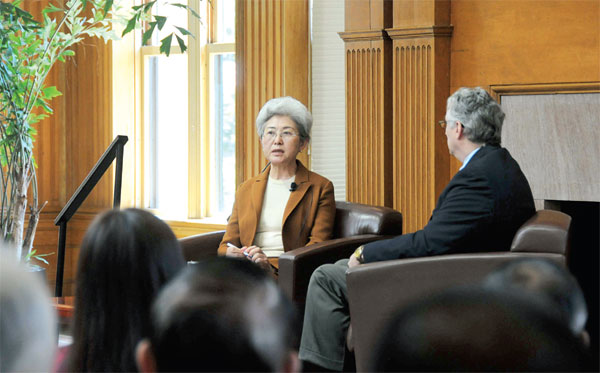
Fu Ying, chairperson of the Foreign Affairs Committee of the National People's Congress, discusses with Professsor Thomas Fingar of the Freeman Spogli Institute for International Studies at Standford Unversity, at a seminar titled Rebuilding Trust: China-US Relations at the university in Palo Alto, California, on May 10. Provided to China Daily |
The world order quo vadis? This is a question that has attracted diverse opinions. There is obviously no consensus yet on how the existing order should be adjusted. More importantly, there is a lack of trust among major countries.
In the history of international relations, trust has been a rare commodity, and the lack of trust remains an impediment to genuine partnerships in today's world.
Take Russia and the United States, for example, 25 years after the end of the Cold War, it is hard to say they have greater trust in each other now.
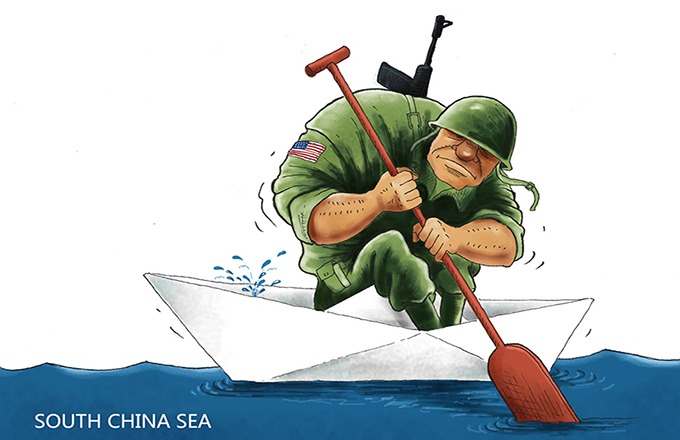
The relationship between China and the US is also often troubled by the lack of trust. In the 30-plus years of its reform and opening-up drive, China has established strong economic ties with the US. However, the South China Sea has brought our conflicting security interests into focus, reminding many in China that in spite of our inseparable interdependence, we are far from partners in the security field.
Am I right to say that the world order the US claims to lead is a power structure, founded on US values, rejecting other ideologies and supported by a military alignment, which does not take into consideration the security interests of others?
In the economic field, the power structure is not that distinct. While it seeks to maintain a global economic framework centered on the US dollar, it has also encouraged globalization which has led to the opening-up of the world economic structure. The UN institutions, G20 and many other organizations are also being encouraged to play growing roles in global economic governance.
China does not have a strategy to challenge the US-led world order, but when it ostracizes the Chinese political system and ignores China's security interests, it is hard for China to support it.
Is the US willing for the world order to be adjusted? I have discussed this with many US scholars and the answer they have given is no.
I remember when talking to Professor John Mearsheimer (professor of political science at the University of Chicago), he told me that "China should either submit or challenge" and that it is only natural that China would seek to replace the US hegemony and the US should counter it.
But is it really an either-or choice? Does it mean when the people in developing countries are lifted out of poverty and start pursuing their dreams of prosperity, there is no avoiding the Thucydides trap?
The Chinese people have their own view of the world order. It is one in which the international order centered on the UN. Chinese President Xi Jinping has said that China "firmly upholds the international order and system underpinned by the purposes and principles of the UN Charter" and together with other countries wants to "make the international order more just and equitable".
You may notice the term we use is "international order". China is among its founders, is a beneficiary, as well as its active supporter and reformer. This international order overlaps, to some extent, with the US-led world order, though each does not include the other in its entirety.
Today's world has long shifted its agenda from bloc politics to development and cooperation. Globalization has facilitated the flow of goods, capital, technology and resources, enabling countries such as China to achieve unprecedented growth.
According to the World Bank, from 1992 to 2014, the world economy more than tripled, growing from $24.7 trillion to $78 trillion, while the global trade volume more than quadrupled, growing from $5.1 trillion to $23.8 trillion. The contribution of emerging markets and developing countries to world growth has risen from 26.97 percent to 61.4 percent. Both the developed and developing world have benefited greatly from this growth.
- China, US cooperation is 'expected'
- China-US movie cooperation keeps gathering steam
- China, US navies work on relations
- Building healthy rhetoric in China-US ties
- Chinese premier says frictions in China-US economic ties are normal
- China, US still hopeful of wrapping up investment talks under Obama administration
- China, US eye growth in tourism