Tackling drug-resistant infections a priority
 |
|
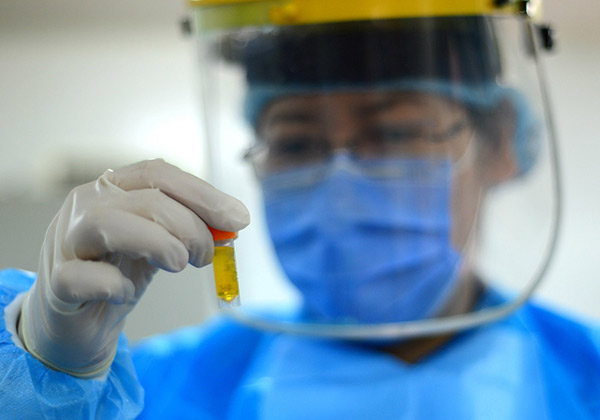
A technician carries out a blood test for HIV virus at Jinan AIDS lab in East China's Shandong province on Nov 30, 2015. [Photo/IC] |
While the last half century has seen major advances in global health, new challenges are now threatening these hard-won health gains. One of these is antimicrobial resistance (AMR), or drug-resistant infections which can no longer be treated by antibiotics and other antimicrobial drugs. AMR is on the increase globally both in humans and animals.
As a physician I'm concerned that if this trend continues unchecked, many common infections will again become untreatable. As a development professional, I'm worried that the impact of AMR could also reverse decades of hard-earned development gains.
New research by the World Bank, entitled Drug-Resistant Infections: A Threat to Our Economic Future, shows that by 2050, the cost of continued inaction on AMR would be higher than that of the devastating financial crisis in 2008-09. Under a worst-case scenario, low-income countries could lose more than 5 percent of their GDP. AMR unchecked could also cause 28 million people, mostly in developing countries, to fall into poverty by 2050. It could also diminish exports by as much as 3.8 percent, thereby reducing global trade. And healthcare costs globally could increase by $300 billion to more than $1 trillion a year by 2050.
Livestock, which are crucial to the diet and incomes of the poorest in developing countries, would also suffer as antimicrobial drugs cease to be effective and more animals will fall sick or die. The decline in global livestock production could range from 2.5 percent to 7.5 percent a year, with up to 11 percent decline in low-income countries, according to the report.
To meet the AMR challenge, we have to tackle shortfalls in regulation of antimicrobial drugs that have resulted in their over-production, over-prescription and over-use while often being of suspect quality. Action must extend to the agriculture sector to curb the widespread use of antibiotics as growth promoters for livestock.
Too many of the poor-especially children-in developing countries still lack access to life-saving antibiotics for conditions such as pneumonia and diarrhea. But this access agenda is being threatened by AMR that is removing effective, low cost drugs to treat widespread infections. For example, malaria deaths among children have plummeted in recent years due in part to the artemisinin-based drugs discovered by the Nobel Prize winning Chinese scientist Tu Youyou, but resistance to artemisinin is growing in the Mekong sub-region close to the border with China. Strong stewardship is needed now to ensure we do not lose one of the world's most effective malaria drugs.
Clean water and sanitation, as well as universal child immunization that prevents common infections that would otherwise require antibiotics, are top priorities in tackling AMR. Enhanced efforts are also required to establish surveillance capacity for early detection of resistant bugs in both humans and livestock. .
There is also an important role for regulations and financial measures. One possibility is to incentivize farmers to use fewer antibiotics in the meat industry and to promote insurance coverage against loss of livestock to disease outbreaks. Another possibility is to encourage consumers to switch to antibiotics-free meat or dairy products, for instance by lowering their relative prices. China has a key role to play in these efforts. Its pork industry, for example, accounts for half of all global consumption, and containing AMR domestically would not only improve public health in China, but also make a major difference globally.
Investing in preparedness for major infectious disease outbreaks and improving public and veterinary health systems are some of the best ways to contain AMR. The World Bank is increasingly financing these capacities. For example, we have invested $1.3 billion in the Global Avian and Human Influenza Preparedness Program, which helped 60 developing countries to improve their animal and public health systems.
The good news is that we do not need a new magic cure, and we are not starting from scratch. The new report is a wake-up call. It makes abundantly clear that the cost of inaction is not affordable-especially for the poorest countries. We need to urgently change course to avert the coming crisis, and as a key economic power China has a special leadership role to play in this effort.
The author is senior director, Health, Nutrition and Population, the World Bank Group.