A shared vision for Belt and Road Initiative
 |
|
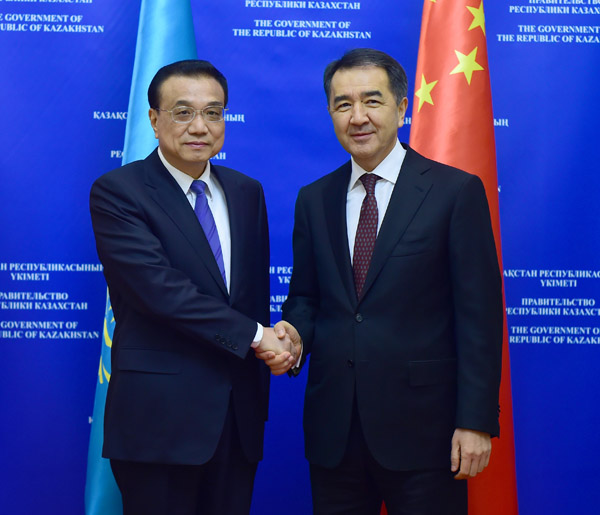
Chinese Premier Li Keqiang, left, shakes hands with Kazakh Prime Minister Bakytzhan Sagintayev in the third regular meeting between the two countries' prime ministers in Astana on Thursday. [Photo/provided to chinadaily.com.cn] |
We live in a world of increasing interdependency and complexity, where international cooperation is necessary, however increasingly multifaceted and complicated. Global challenges such as climate change, global health and security issues require ever-higher degrees of global effort and collaboration if they are to be overcome. This calls for new ideas on how to make global governance work better for all countries and people.
In the light of this, the Belt and Road Initiative (the Silk Road Economic Belt and 21st Century Maritime Silk Road), potentially the world's largest economic corridor, is part of a new trend and an innovative contribution to global governance. It represents an opportunity to build a shared vision for common prosperity through regional cooperation, and could act as an accelerator for achieving the United Nations Sustainable Development Goals.
The Belt and Road Initiative covers a vast population of 4.4 billion and an economic output of $21 trillion in more than 70 countries in Asia and the Pacific, Europe and Africa. The majority of them are emerging and developing countries. Through connectivity, it aims to foster trade, financial integration and people-to-people bonds, while promoting inclusiveness and win-win cooperation-hence reshaping the landscape of international cooperation.
A key strength of the initiative is that it strategically targets recipient countries' development gaps. According to a joint study by the Asian Development Bank, UN Economic and Social Commission for Asia and the Pacific and the UN Development Programme (Making it Happen, 2015), in the Asia-Pacific region alone, the total financing requirement for infrastructure is $8.3 trillion between 2010 and 2020, or $750 billion per year.
While the majority of financing is expected from government revenues, foreign direct investment will play an increasingly important role-making the Belt and Road Initiative a powerful framework for facilitating its flow.
Some countries are already fully engaged and investment and trade are expanding rapidly.
Outbound direct investment made by Chinese companies to countries along the Belt and Road reached $12 billion in the first three quarters of 2015, up 66 percent year-on-year.
The question is how these investments can bring not only economic development, but also human development benefits along the way. The Belt and Road Initiative will contribute to improved infrastructure and industrialization, but it should not stop there, and must also transform local communities and help reduce poverty and protect the environment, and facilitate inclusive social development, contributing to the achievement of UN Agenda 2030.
Highlighting sustainability is a critical aspect of the initiative's credibility, and the synergies and complementarities between initiative and the SDGs can help create a win-win outcome. The initiative's success will critically depend on the ability to contribute to national and local development objectives, and inter alia improving the livelihoods of local communities, through, for example creating decent jobs, increasing capacities and overall living standards.
The broader UN system, including agencies, such as United Nations Development Programme, UN Children's Fund and UN Industrial Development Organization, is ready to play a facilitating role to ensure alignment of the Belt Road Initiative with the SDGs. UNDP recently signed an agreement with the government of China, aiming to support China and the other countries along the Belt and Road in achieving their development aspirations, building more consensus, providing analytical basis for policymakers to engage on the initiative, and identifying practical projects coupled with investments to ensure that common economic prosperity will go hand-in-hand with inclusive social and environmental gains.
The Global Governance Forum brings together 14 Belt and Road countries, UN officials, development practitioners, think tanks and the private sector to explore a collective plan for concrete actions. This is just the beginning. We have a long road ahead of us, but all of us working in the UN system truly believe that development can be achieved only through a broader vision bringing together ideas, resources and partners with capacity to reach the common goal of shared prosperity for sustainable development.
The author is UN resident coordinator and UNDP resident representative in China.