Trump faces tough Asia-Pacific challenge
 |
|
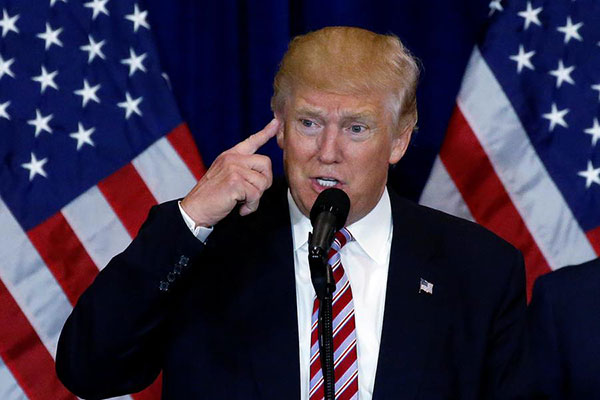
Republican presidential candidate Donald Trump speaks at a post Republican Convention campaign event in Cleveland, Ohio, July 22, 2016. [Photo/Agencies] |
After Donald Trump is sworn in as the president of the United States on Jan 20, the biggest foreign policy challenge for his new administration will be how to deal with the fast-developing situation in the Asia-Pacific region.
 |
|
Zhang Zhixin [China Daily] |
Besides, since Trump, during his election campaign, threatened to reduce, if not end the US' defense commitments toward its Asia-Pacific allies such as Japan and the Republic of Korea, he either has to pay early visits to those countries or explain that there will be no change in his administration's Asia-Pacific policy to reassure them of continued US support.
Trump did try to do that in his victory speech by saying: "We will get along with all other nations ... willing to get along with us ... We will have great relationships." But that will not be enough.
Trump's second, and perhaps more important, challenge will be how to treat the China-US relationship. The strategic competition between Beijing and Washington is mostly in relation to a third party-for example, China's dispute with Japan in the East China Sea and its disputes with some other neighbors in the South China Sea. Which means future China-US relations will largely depend on Washington's policy toward Beijing and Sino-US interactions.
Whether or not the US continues to take measures to slow, if not contain, China's rise will determine regional peace and prosperity. If the Trump administration were to include Taiwan into Washington's "rebalancing to the Asia-Pacific" strategy, it could lead to a much-dreaded standoff between China and the US. But no one expects it to do so.
Trade and economic frictions are expected to increase, though, because being a businessman, Trump has his own ideas about trade and during his election campaign, he vowed to act tough on China.
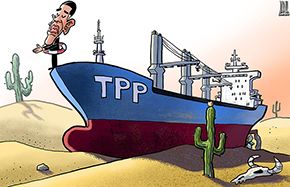
And although the US Congress is not likely to approve the Trans-Pacific Partnership Agreement, the Trump administration may put it back on the policy agenda after revising it, because it is aimed at furthering American interests.
Besides, the deadlock of TPP will be a chance for China to promote the negotiations on the Free Trade Area of the Asia-Pacific, and enhance its cooperation with ASEAN in the talks of Regional Comprehensive Economic Partnership, the competition between Washington and Beijing to write the trade rules will continue.
The most pressing security challenge for the region is the Democratic People's Republic of Korea nuclear issue. The "strategic endurance" policy used by the Barack Obama administration to deal with the issue has not succeeded, as many in the US strategic circle say. The DPRK is pushing the envelope by testing missiles and conducting nuclear tests. To prevent Pyongyang from mastering advanced missile technology and thus becoming capable of striking the US homeland, many experts suggest Washington launch preemptive strikes on the DPRK, which would lead to a greater crisis.
Given that diplomacy in the Middle East, Latin America and Africa is not likely to yield significant results for the US, the DPRK nuclear issue could probably be the first foreign policy target in the first year of the incoming Trump administration. And with the Six-Party Talks being suspended, Trump has to find a new way to negotiate with the DPRK, which could really restructure the regional security situation.
The author is the head of American Political Studies at the Institute of American Studies, China Institutes of Contemporary International Relations.
- Sino-US relations in the Trump era
- Economists predict uncertain trade outlook in Trump presidency
- Obama tries out the high road on Trump
- Trump names Priebus, Bannon to senior White House roles
- Xi, Trump discuss China-US cooperation
- Xi Jinping has telephone conversation with US President-elect Donald Trump
- What Trump's Election Means for China
- Trump's foreign policy cause of concern for Abe