Braving the growing challenges of UN peacekeeping
 |
|
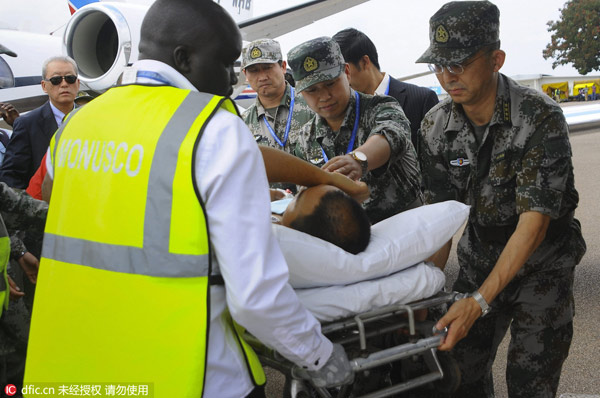
Critically injured Chinese peacekeeper Chen Ying (C) is carried on a stretcher by fellow Chinese peacekeepers as Chinese ambassador to Uganda Zhao Yali (L) looks on after Chen was evacuated from Juba, South Sudan, upon arrival at the Entebbe International Airport in Uganda, July 14,?2016. [Photo/IC] |
When the bodies of three Chinese soldiers were taken home from Mali and South Sudan in June and July, the shock waves felt throughout China reminded people how dangerous peacekeeping had become.
Peacekeeping operations have entered an area of unpredictable deep waters. The number of major violent conflicts has almost tripled since 2008 while United Nations missions have become much diversified.
For example, in the UN Multidimensional Integrated Stabilization Mission in the Central African Republic, peacekeepers' tasks included protection of civilians and support for the transition process; facilitating humanitarian assistance; promotion and protection of human rights; support for justice and rule of law; and disarmament, demobilization, reintegration and repatriation processes. In contrast, in the first UN peacekeeping mission in 1948, the only task was observing a ceasefire.
Protection of civilians has become a priority. Of the 16 current missions under the UN flag, 10 have specific mandates for the protection of civilians. For this very purpose, the UN has taken a most revolutionary step in peacekeeping - to announce the establishment of a 4,000-strong rapid deployment force by 2016. This "avant-garde brigade" will comprise the elite troops selected from contributing countries, including China. The hope is that at the shortest notice they could be deployed in war-torn countries where there are no political agreements or even peace to keep.
The questions that arise for the peacekeepers are: How do they identify enemies from civilians? How do they minimize the harm caused to civilians if they have to shoot? And how do they prevent growing suicide attacks against themselves?
Although China has been involved in peacekeeping since 1990, Chinese security guards were sent to serve in UN missions only at the end of 2013. They, along with the first infantry battalion sent to South Sudan in 2015, have had to learn quickly how to handle complicated missions in which the tasks are diversified. The lessons learnt from the recent casualties in Mali and South Sudan, among others, are that they have to establish a good relationship with host countries' leaders, engage with local leaders and NGOs, understand the population's perspective on threat and have better information.
Use of force is another challenge for them. "No use of force except in self-defense and defense of mandate" is one of the three principles for peacekeeping. For self-defense, the question is what rules of engagement to apply in the changing situations. But defending the mandate with use of force is often debated. Some argue that the potential attackers will not attack if they know UN troops would certainly respond forcefully, but there are others who argue that use of force may actually contribute to proliferation of a raging conflict and make peacekeepers themselves the targets of attacks.
Besides, the government of the host country may not necessarily be friendly toward peacekeepers, particularly if it turns out to be the perpetrator and if it believes the peacekeepers are, in fact, helping its opponents.
To kill or not to kill? That is a question of great importance for Chinese peacekeepers after they lose their comrades. Although quite a few UN resolutions have authorized peacekeepers to "take (use) all necessary means" and even "use force" to protect civilians, the mandate, by all means, should not be simply taken as a "license to kill". The use of caution by China in using force resonates with UN peacekeeping guidelines of impartiality and no use of force in general. But in two consecutive months, Chinese peacekeepers have been killed. What if these killings continue? And when is enough enough?
The number of UN peacekeeping operations today is higher than at any time in history, but still the proliferation of conflict is outpacing the efforts. The expectations on China are high. In peacekeeping, China is unique in combining huge interests, great capacities and rich resources. China is already the largest troop contributor among the five permanent UN Security Council members and the second-largest financial contributor.
China's announcement in 2015 to set up an 8,000-strong peacekeeping standby force is a clear signal of its greater and irreversible involvement in the years to come. If indeed peacekeeping operations are synonymous with the UN, then peacekeepers are the best thing China can provide for the very purpose inscribed in the beginning of the UN Charter, that is, to "save succeeding generations from the scourge of war".
The author is an honorary fellow with the Center of China-American Defense Relations, Academy of Military Science.
(China Daily 11/19/2016 page5)