Seoul-Tokyo pact an invitation to trouble
 |
|
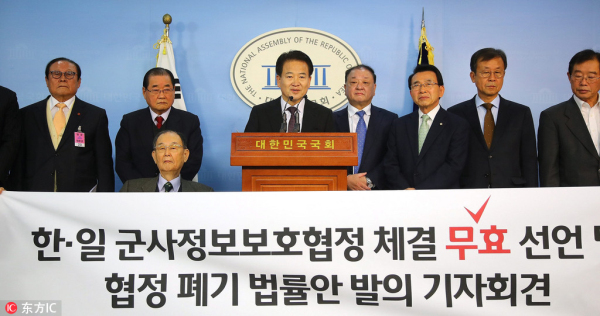
South Korean Rep. Chung Dong-young (C) and other opposition lawmakers hold a press conference at the National Assembly in Seoul, South Korea, 25 November 2016, before submitting a bill aimed at nullifying a Seoul-Tokyo military intelligence-sharing agreement that took effect the previous day. The controversial pact is designed to better monitor North Korea.[Photo/IC] |
Despite the fierce domestic opposition, the Republic of Korea signed an agreement on sharing military intelligence with Japan on Wednesday. The pact will allow the two countries to directly share information on the Democratic People's Republic of Korea without first going through US intelligence.
At a news conference on the same day, Chinese Foreign Ministry spokesman Geng Shuang criticized the agreement, warning that strengthened military intelligence sharing between some countries because of their Cold War mentality would "aggravate antagonism and confrontation on the Korean Peninsula".
Seoul's "hasty" decision to freely exchange information with Tokyo, and their common ally Washington, is essentially in line with the major changes in its foreign policy. Just two months ago, the DPRK conducted the fifth nuclear test since 2006 and the second this year, giving enough reasons for the ROK's increasingly assertive response.
Apart from pressing ahead with the deployment of the Terminal High Altitude Area Defense anti-missile system on ROK soil, President Park Geun-hye paid a rare visit to Iran in May, possibly to draw inspiration from the Iran nuclear deal.
It is also highly likely that Park has more in mind than national security. Trapped in a major influence-peddling scandal, she has been confronted with several mass demonstrations demanding her resignation. The embattled ROK president has good reasons to pursue diplomatic breakthroughs, in order to divert public anger and prove to the opposition that she is still in charge and capable of fulfilling her presidential duties.
The Seoul-Tokyo military intelligence-sharing pact, on the other hand, showcases the ROK's inclination to consolidate its relations with the United States. Technically, the pact is unlikely to make any difference for Seoul if it truly seeks to "better manage the threats" from Pyongyang, because Japan's intelligence on the DPRK, basically gathered by Japanese satellites and radar systems, is questionable. Limited channels for collecting such information aside, the much-desired exchange of intelligence between Seoul and Tokyo largely would overlap that between Seoul and Washington.
This contradiction is exactly what the opposition and many enraged ROK citizens have been urging Park to explain. Her decision to cut the deal by bypassing the opposition and parliament also lacks procedural legitimacy and public support.
Many ROK citizens remain wary of the deepening ROK-Japan ties when Japan is yet to atone for its aggression and atrocities in their country. Protests are held from time to time over the thousands of Korean "comfort women" forced into sex slavery during World War II.
The intelligence-sharing pact makes clear Park's intention that her government will follow the US' lead in major strategic issues, and her willingness to step up the trilateral military cooperation with the US and Japan regardless of the political pressures at home. It also suggests Seoul is more open to confrontation and flexing of muscles, instead of peaceful dialogues, in handling the DPRK nuclear issue.
However, history tells us such an approach will not work in the foreseeable future. Instead, it could backfire. Pyongyang has reportedly criticized the military intelligence-sharing pact as "a dangerous act" that would heighten tensions on the Korean Peninsula and open the door to a "re-invasion" by Japan. As such, the pact could prompt Pyongyang to take a tougher stance against Seoul and thus deal another blow to their already shaky relations.
Tensions may escalate and spill over into other regional countries, adding fuel to an emerging security confrontation. Washington and Tokyo are very likely to use the pact to contain and keep a closer eye on Beijing and Moscow, in the name of beefing up defense cooperation. But the biggest victim of all will be the ROK itself because it lacks the capacity to maneuver its way out of a conflict, even if the pact takes effect.
The author is a researcher of Asia-Pacific strategy at the Chinese Academy of Social Sciences. The article is an excerpt from his interview with China Daily's Cui Shoufeng.