Is the sharing economy overvalued?
 |
|
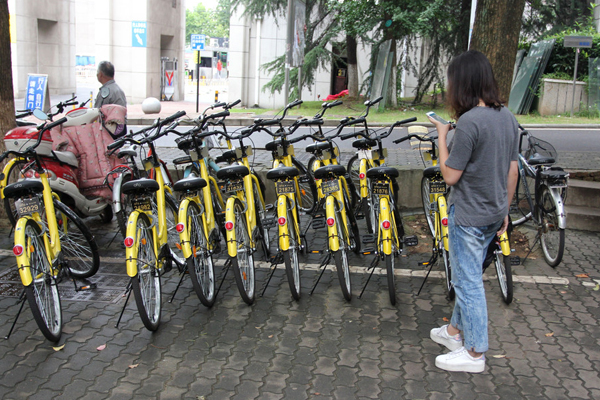
Ofo bikes are lined up in the campus of Zhongnan University of Economics and Law in Wuhan, Central China's Hubei province, June 24, 2016. [Photo/IC] |
With the sharing economy becoming a trend across the world, its development in China is both promising and controversial. The sharing economy first made its mark in China in 2011; today it has entered what many consider its golden development period. Regarding the sharing economy as one of the core directions of new economy, this year's Government Work Report vowed to help its development.
The sharing economy has penetrated into 10 major domestic sectors and more than 30 sub-sectors, including transportation, second-hand online transactions as well as peer-to-peer (or P2P) lending. In fact, in just a few years, sharing-economy companies worth $1 billion or more have emerged in China.
But the sharing economy also faces challenges. For instance, once sharing-economy businesses become full-time vocations, will they deviate from their original goal of sharing and effectively using idle social resources?
Striking the right balance between innovative supervision and encouraging development is another difficulty the sharing economy faces. The merger between the two top domestic ride-hailing service providers Didi and Uber, which were also the market leaders of the sharing economy, had to face not only an antitrust investigation but also has been subjected to specific regulations in specific areas. The P2P lending market calmed down only after the strictest P2P financial regulation was issued.
Moreover, many sharing-economy startups are forced into homogeneous competition for the lack of efficient profit-making models.
So, have the prospects of the sharing economy been overestimated? And how does one evaluate the value of the sharing economy and the revolution it may bring?
The sharing economy has great potential. It is not only a business model, but also a new socio-economic operation model. Through "Internet Plus", the sharing economy tries to connect the idle social resources at low costs and an efficient manner.
Against the background of the Chinese economy's new normal, the sharing economy aims to activate idle resources and use them to the maximum advantage. The development of the sharing economy will not only create new jobs and provide income for more people, but also help build a new growth pole for consumption. Hence, the sharing economy is expected to become a new engine of economic growth.
In 2013, the sharing economy accounted for 1.3 percent of the United Kingdom's GDP, and the country is taking measures to increase the proportion to 15 percent in five years. In China, although the scale of the sharing economy has exceeded 1 trillion yuan ($144 billion), it still accounts for a small proportion of the country's GDP, which means it still has enormous developing space.
Given China's demographic dividends, the sharing economy has plenty of areas to explore. For instance, in 2015 the number of orders China's top ride-hailing service provider Didi reached 1.43 billion, more than the total number of orders Uber has received since it was founded.
A broader development space for the sharing economy is sharing for enterprises and means of production, to cash in on the opportunities created by "Internet Plus" and the industrial upgrading in China.
The power of the sharing economy is also evident in the changes it has effected in social operation models such as life and working styles, enterprises' organizations and cultural values. It allows individuals to engage in various fields to give full play to their talents and traditional enterprises to share talents and even turn into "virtual" enterprises. The sharing economy is also expected to reshape people's idea of ownership of materials and enhance trust and cooperation among individuals.
To meet the challenges it faces and resolve its conflicts with traditional industries and existing systems, the sharing economy has to chart a novel path for itself while respecting the rule of law, which in turn will help it to fulfill its potential of building a connection between the old and new economic engines in China.
The author is a senior researcher of Tencent Research Institute.