How will Brexit affect EU and China?
 |
|
CAI MENG/CHINA DAILY |

In the six months since the United Kingdom voted to leave the European Union, the impact on EU's economy has been barely noticeable. A small dip in economy-wide confidence in July and August quickly reversed, and a modest recovery across the region has continued uninterrupted. Looking forward, indicators of activity even suggest that business activity is picking up.
However, economic and political risks are likely to intensify next year, once the UK government formally begins the process of withdrawing from the EU. In the UK, the Brexit negotiations will generate uncertainty about the short- and medium-term economic outlook for the country. Combined with a sharp rise in costs stemming from the pound's depreciation in 2016, this is likely to result in a slump in domestic demand and a slowdown in the pace of economic growth in 2017.
For Europe, the projected economic slowdown in the UK will undermine export revenue in countries with the largest trade exposures, notably Ireland, the Netherlands, Belgium and Cyprus. Most other EU countries have modest trade ties with the UK, but those with foreign direct investment in the UK or close links to its banking sector may also be adversely affected, including Cyprus, France, Belgium, the Netherlands, Germany, Finland, Greece and Spain.
Overall, the short-term economic fallout from Brexit will be modest for the EU. The UK's departure from the EU will exacerbate weaknesses that have been holding back the region's economic recovery in recent years, particularly as EU leaders turn their attention away from domestic issues, such as reform efforts, and focus on negotiations with the UK. But the political ramifications for the EU of Brexit have the potential to be much greater.
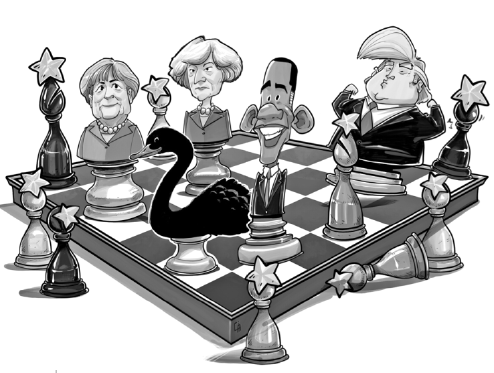
The Brexit process will get under way at a time of heightened political risks in the EU, providing the backdrop to important popular votes in which anti-establishment forces are challenging the mainstream political parties.
In the Netherlands parliamentary elections in March, the far-right Freedom Party of Geert Wilders is expected to do well, potentially becoming one of the largest parties in parliament, although it is unlikely to be part of the next government. Although we (at The Economist Intelligence Unit) do not think far-right National Front candidate Marine Le Pen will win France's presidential election in 2017, the risk of this outcome has increased significantly. Even in Germany, where populism has been a less potent force than elsewhere on the continent, support for the far-right Alternative for Germany has surged over the past 18 months and the party is on course to win enough votes in the federal election in September/October 2017 to gain seats in the Bundestag.
In Britain's EU referendum, the majority of voters defied the political establishment by opting to leave the EU. The Brexit vote could embolden populist challenges across the EU, where similar factors are driving voter disaffection with the political elite. It is clear that Britain is not alone in this respect. Britain may always have had one foot in and one foot out of the EU and Euroskepticism has been around a lot longer, but it has become increasingly clear in recent years that voter disaffection across the European continent is being driven by declining trust in government institutions, parties and politicians and a growing gap between the values espoused by political elites and large swathes of the electorate.
This disaffection is directed not only against national political elites, but increasingly against the EU's supranational institutions. The Brexit vote has now opened the door to Euroskeptic politicians in the EU to ask their electorates to consider life outside the EU. Demand in other European countries for referendums on EU membership may increase next year.
For China, the political and economic fallout of Brexit will be relatively small in 2017. Bilateral trade ties with the UK are minuscule, accounting for only 2 percent of China's total external trade. The EU is China's largest export market, but we expect only a limited impact on demand in the region from a projected economic slowdown in the UK. China's investment ties with the UK are stronger than its trade ties, especially in the UK's property market. The pound's depreciation since the vote has also shaken assumptions about long-term UK investments in fields such as infrastructure, which was earlier seen as offering stable, dependable returns.
The UK has been one of the main proponents of closer trade ties between the EU and China, and so the loss of the UK as a supportive voice for China within the EU could be a blow for Beijing. However, the Brexit vote and populist tumult across the EU will add to the bloc's difficulty in forming a united front on any given policy, which may offer China opportunities to advance its own policy preferences.
Whatever the opportunities the splits within EU offer, the underlying message for China seems to be negative. As in the United States, the mood is turning against globalization in the EU. In the end, that is going to be damaging for China as it seeks access to export markets and opportunities for outbound investments.
The author is an analyst for Europe at The Economist Intelligence Unit.