Fight against terrorism has bumpy road ahead
 |
| Luo Jie/China Daily |
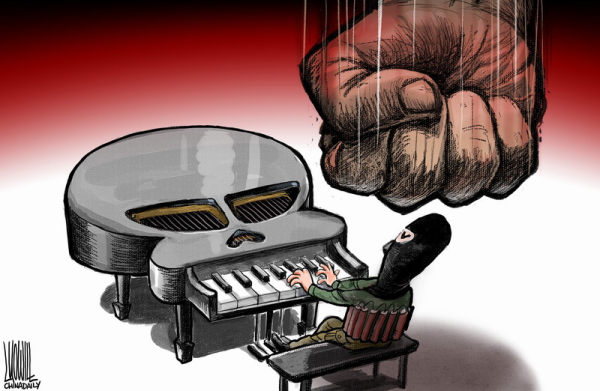
Three audacious terrorist attacks on Dec 19 left the world horrified. Perhaps the most chilling of those attacks was the assassination of Russia's ambassador to Turkey Andrei Karlov in Ankara. The assassin, an off-duty police officer, pulled out a gun while Karlov was several minutes into a speech at an art exhibition and shot up to eight times, shouting "Don't forget Aleppo, Don't forget Syria".
In Berlin, a truck plowed through a Christmas market, killing 12 people, which German Chancellor Angela Merkel described as a "terrorist" attack. The suspect, a Tunisian national, was killed in a shootout with police officers in Milan, Italy, on Friday.
And in Zurich, Switzerland, three people were wounded when a gunman opened fire in a mosque frequented by Somali immigrants.
Despite Karlov's assassination, however, Russia and Turkey have vowed to maintain their detente and work together to "invigorate" a political resolution to the Syrian conflict, which in turn, they said, will defeat the designs of the perpetrators to create a chasm between the two countries. The needed response, Russian President Vladimir Putin said, would be to strengthen the fight against terrorism.
However, it is too early to say whether the assassination of Karlov was a result of extreme individual expression of political opinion, or organized opposition to Turkey's efforts to improve relations with Russia.
The two countries, along with Iran, have made notable progress in jointly handling the Syrian crisis despite their longstanding differences. The key disagreement between Moscow and Ankara lies in their stance on Syrian leader Bashar al-Assad. Moscow and Teheran stand firmly behind Assad, whereas Ankara does not trust him and has been backing the Syrian opposition forces.
But Turkey also wants a secure border and wider support for its efforts to neutralize the independence-seeking Kurdish forces in the southeastern part of the country. Apparently the Turkish government is more desperate to prevent the Syrian Kurds from growing stronger and seek an independent homeland with their compatriots in Turkey and Iraq.
Yet Turkey's concerns were not properly addressed by the United States, which explains why it turned to Russia, which has gained a bigger say in the Syrian crisis. Combating extremist groups in Syria with Russia is also in line with Turkey's national interest.
Factors that have led to increasing terrorist attacks in Europe-from Belgium to France to Germany-and the Middle East, especially Turkey, in recent years, are interwoven. In Europe's case, the sluggish economic recovery has not only dealt a blow to people's livelihood and welfare but also triggered blind hatred toward immigrants, creating deeper divisions and violent reactions.
Besides, violent attacks might be carried out by armed terrorists and homegrown extremist groups, or both, trying to make their voices heard. In the long run, with the Islamic State group struggling to regain its footing in Iraq and Syria, the chances of terrorism spilling over into Europe could increase. The recent terrorist attacks in Turkey, however, are clearly targeted at the Turkish government, and possibly carried out by Kurdish militants.
It is noteworthy that both the European Union and Turkey have reached a historical turning point in their involvement in the Middle East. Turkey is struggling to contain the Kurdistan Workers' Party, and the EU is still seeking ways to deal with the ongoing refugee crisis and the rise of populism in some member states. But neither Turkey nor a weakened EU can heal the wounds in the short term.
The second round of globalization since the 1980s has mostly benefited the financial and high-tech industries in the West, but left the manufacturing sector in deep trouble. More Westerners tend to blame the rise of export-oriented emerging economies and the influx of immigrants for their waning benefits, further fueling protectionist sentiments. And the foreseeable spread of terrorism to other regions and frictions between major powers point to a bumpy road ahead for all parties involved in the Middle East.
The author is an associate professor at the History Department of Peking University, and director of the Turkey studies center at Pangoal Institution, a Beijing-based think tank.