 |
|
[Photo by China Daily] |
Insiders say there's a silver lining to stagnant box office takes in 2016. Box office takes for China's film industry remained stagnant in 2016, but most industry insiders see it as a blessing in disguise.
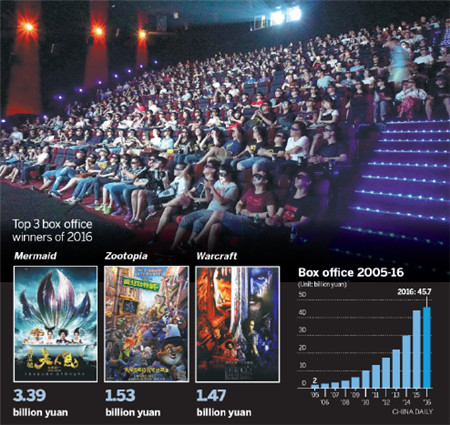
Last year's box-office total was predicted to reach 60 billion yuan ($8.64 billion). Instead, at 45.712 billion, it grew a mere 3.73 percent over 2015's 44 billion yuan, the lowest in a decade.
However, experts said 2015's 49-percent growth rate, the highest on record, was partly the result of a bubble.
Although box-office receipts stalled in 2016, the buildup of movie theaters rushed ahead at breakneck speed, with about 26 new screens a day, or 9,552 in a year. China now has 41,179 movie screens in total, the most in the world, and 85 percent of them are capable of projecting 3-D films.
Newly released data by the State Administration of Press Publication, Radio, Film and Television, the industry's regulator, shows that domestic films accounted for 58.33 percent of the year's box office total. Annual attendance reached 1.37 billion tickets, an increase of 8.89 percent year-on-year.
In the same report, overseas box office figures for Chinese films were shown as 3.825 billion yuan, a rise of 38 percent. The number of feature films produced in China was 772, with an additional 49 animated features.
There was a sweeping transformation in the early summer of 2016 when ticket subsidies were phased out. Such subsidies, mostly from online retailers, reportedly accounted for 10 percent of 2015's total take. Subsidy-enabled low prices were blamed by many for creating a new audience mentality that movie tickets should be much lower than normal.
Worse than subsidies was so-called phantom attendance, which refers to blocks of seats bought by the film companies themselves to create an illusion of high audience turnout. Although the practice started as a plan to generate real attendance down the road-similar to authors buying their own books from designated bookstores to get on the best-seller list-it evolved into a financial tool to jack up corporate valuation.
The crackdown in March last year by government regulators investigating the distributor for Ip Man 3 effectively put a stop to such practices. This caused a dip in revenues for several months of 2016.
"A proper downsizing of the film market is beneficial to the health of the industry," said Dai Jinhua, a film scholar at Peking University. "China's film market, even if scaled down, is still flush with capital. But this infusion of money must not be used to dominate the film market with quick profits and speculation."
The flat performance of 2016 has also been attributed to a shortage of runaway hits. Except for the pre-crackdown box-office record of The Mermaid, which stands at 3.39 billion yuan, other blockbusters were all in the range of 1 billion to 1.5 billion yuan. Of these, only Zootopia (1.5 billion yuan), an import, and Operation Mekong (1.18 billion yuan) relied on word of mouth to propel sales above the 1 billion yuan mark. Others were all products of franchises.
However, not every star-studded epic built around a wildly popular book or story ended up in that league. Many fell flat on the market, due to growing sophistication of moviegoers. The failure of the erstwhile winning formula with L.O.R.D (Legend of Ravaging Dynasties), at 382 million yuan, and League of Gods, at 284 million, offered a cautionary tale for new players who come to the industry with loads of money but little knowledge.
The financial game of minimum guarantee also failed spectacularly in 2016. Both League of Gods and Ip Man 3 were guaranteed a minimum box office return of 1 billion yuan, for example, but fell far short.
"We may have more screens and a bigger market, but we also have more movies that are dumbed down and brainless. But audiences are going through a change. They are less willing to buy tickets to movies with only visual spectacles and all-star casts," said Liu Zhenyuan, a screenwriter whose novel I Am Not Madame Bovary spawned an award-winning comedy that raked in 483 million yuan at the box office.
The year 2016 could also be a turning point for the perceived clout of the pop idol pretty boys. Many projects built around them, usually romances, had only middling performances at the market, and their average box office returns were noticeably lower than similar genres from previous years.
Some of these pop idols had such bad attitudes in the workplace-shooting only close-ups and leaving the rest for body doubles, for example-that Jackie Chan, a titan of the industry legendary for his work ethics, threatened to "out" them.
Quality films enjoyed a modest revival last year. The biggest event was the performance of Song of the Phoenix, a little film directed by the late master Wu Tianming, often deemed "father to the Fifth Generation". It reached 85 million yuan after producer Fang Li made headlines by publicly genuflecting to the nation's cinema managers.
Art-house champions saw Song of the Phoenix as evidence that there is a market for such offerings and movie theater chains should heed this pent-up demand.
Other auteur-oriented fare still resorts to star power and international award recognition for publicity, but unlike in previous years, more people apparently are realizing that the quality of a film may not necessarily translate into market performance.
Rao Shuguang, secretary-general of the China Film Association, said that short-term and "non-professional" capital would beat a retreat when it failed to reap the anticipated financial rewards, thus hampering the growth rate of the industry but also squeezing air from the bubble. "Overall, China's film industry is entering a more rational phase of development."
Insiders say there's a silver lining to stagnant box office takes in 2016 RAYMOND ZHOU Box office takes for China's film industry remained stagnant in 2016, but most industry insiders see it as a blessing in disguise.
Last year's box-office total was predicted to reach 60 billion yuan ($8.64 billion). Instead, at 45.712 billion, it grew a mere 3.73 percent over 2015's 44 billion yuan, the lowest in a decade.
However, experts said 2015's 49-percent growth rate, the highest on record, was partly the result of a bubble.
Although box-office receipts stalled in 2016, the buildup of movie theaters rushed ahead at breakneck speed, with about 26 new screens a day, or 9,552 in a year. China now has 41,179 movie screens in total, the most in the world, and 85 percent of them are capable of projecting 3-D films.
Newly released data by the State Administration of Press Publication, Radio, Film and Television, the industry's regulator, shows that domestic films accounted for 58.33 percent of the year's box office total. Annual attendance reached 1.37 billion tickets, an increase of 8.89 percent year-on-year.
In the same report, overseas box office figures for Chinese films were shown as 3.825 billion yuan, a rise of 38 percent. The number of feature films produced in China was 772, with an additional 49 animated features.
There was a sweeping transformation in the early summer of 2016 when ticket subsidies were phased out. Such subsidies, mostly from online retailers, reportedly accounted for 10 percent of 2015's total take. Subsidy-enabled low prices were blamed by many for creating a new audience mentality that movie tickets should be much lower than normal.
Worse than subsidies was so-called phantom attendance, which refers to blocks of seats bought by the film companies themselves to create an illusion of high audience turnout. Although the practice started as a plan to generate real attendance down the road-similar to authors buying their own books from designated bookstores to get on the best-seller list-it evolved into a financial tool to jack up corporate valuation.
The crackdown in March last year by government regulators investigating the distributor for Ip Man 3 effectively put a stop to such practices. This caused a dip in revenues for several months of 2016.
"A proper downsizing of the film market is beneficial to the health of the industry," said Dai Jinhua, a film scholar at Peking University. "China's film market, even if scaled down, is still flush with capital. But this infusion of money must not be used to dominate the film market with quick profits and speculation."
The flat performance of 2016 has also been attributed to a shortage of runaway hits. Except for the pre-crackdown box-office record of The Mermaid, which stands at 3.39 billion yuan, other blockbusters were all in the range of 1 billion to 1.5 billion yuan. Of these, only Zootopia (1.5 billion yuan), an import, and Operation Mekong (1.18 billion yuan) relied on word of mouth to propel sales above the 1 billion yuan mark. Others were all products of franchises.
However, not every star-studded epic built around a wildly popular book or story ended up in that league. Many fell flat on the market, due to growing sophistication of moviegoers. The failure of the erstwhile winning formula with L.O.R.D (Legend of Ravaging Dynasties), at 382 million yuan, and League of Gods, at 284 million, offered a cautionary tale for new players who come to the industry with loads of money but little knowledge.
The financial game of minimum guarantee also failed spectacularly in 2016. Both League of Gods and Ip Man 3 were guaranteed a minimum box office return of 1 billion yuan, for example, but fell far short.
"We may have more screens and a bigger market, but we also have more movies that are dumbed down and brainless. But audiences are going through a change. They are less willing to buy tickets to movies with only visual spectacles and all-star casts," said Liu Zhenyuan, a screenwriter whose novel I Am Not Madame Bovary spawned an award-winning comedy that raked in 483 million yuan at the box office.
The year 2016 could also be a turning point for the perceived clout of the pop idol pretty boys. Many projects built around them, usually romances, had only middling performances at the market, and their average box office returns were noticeably lower than similar genres from previous years.
Some of these pop idols had such bad attitudes in the workplace-shooting only close-ups and leaving the rest for body doubles, for example-that Jackie Chan, a titan of the industry legendary for his work ethics, threatened to "out" them.
Quality films enjoyed a modest revival last year. The biggest event was the performance of Song of the Phoenix, a little film directed by the late master Wu Tianming, often deemed "father to the Fifth Generation". It reached 85 million yuan after producer Fang Li made headlines by publicly genuflecting to the nation's cinema managers.
Art-house champions saw Song of the Phoenix as evidence that there is a market for such offerings and movie theater chains should heed this pent-up demand.
Other auteur-oriented fare still resorts to star power and international award recognition for publicity, but unlike in previous years, more people apparently are realizing that the quality of a film may not necessarily translate into market performance.
Rao Shuguang, secretary-general of the China Film Association, said that short-term and "non-professional" capital would beat a retreat when it failed to reap the anticipated financial rewards, thus hampering the growth rate of the industry but also squeezing air from the bubble. "Overall, China's film industry is entering a more rational phase of development."
(China Daily USA 01/03/2017 page5)


The year 2016 marks my second time saying farewell to full-time motherhood and back to "normal".

Copyright 1995 - . All rights reserved. The content (including but not limited to text, photo, multimedia information, etc) published in this site belongs to China Daily Information Co (CDIC). Without written authorization from CDIC, such content shall not be republished or used in any form. Note: Browsers with 1024*768 or higher resolution are suggested for this site.
License for publishing multimedia online 0108263 Registration Number: 130349