Balance financial reform and stability
 |
|
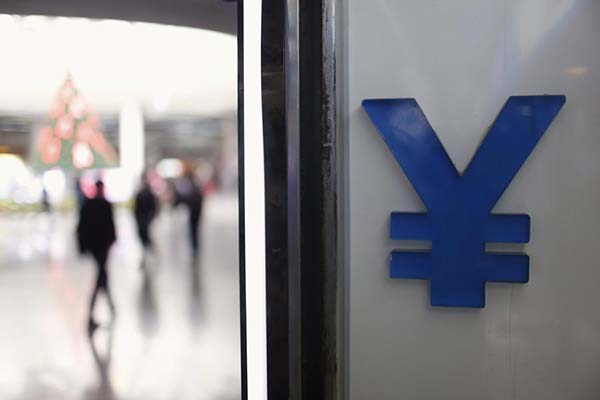
A logo of yuan is seen at a foreign exchange store in Shanghai, China, December 1, 2015.[Photo/Agencies] |
Chinese people find it more complicated to convert the yuan into the dollar, although the $50,000 annual quota of foreign currency a person can purchase (or exchange) remains unchanged.
The State Administration of Foreign Exchange, in a notice issued on Sunday, has tightened scrutiny of foreign exchange conversion by requiring people to give additional information and proper explanation for converting one currency into another. This is understandable because the yuan depreciated by as much as 7 percent against the dollar in 2016, while the country's foreign exchange reserves fell from nearly $4 trillion in the middle of 2014 to about $3 trillion by the end of November 2016.
The flight of capital from China is behind the foreign exchange reserve meltdown, and if it is not stemmed, investors will speculate the yuan will continue to fall, generating more pressure for the further depreciation of the currency and continued contraction of the foreign exchange reserves-a vicious circle the monetary regulator would like to avoid at all costs.
Following the interest rate hike by the US Federal Reserve in December and indications that more hikes may be in the pipeline, more capital may flow into the US from the emerging markets, putting policymakers of those economies, including China, under heavy pressure because the policies they can use are actually quite limited.
In China's case, for example, if it follows the Fed and raises interest rates to curb the flight of capital, then the corporate sector will suffer another blow given the already chilly macroeconomic environment; worse, the real estate price bubble may burst destabilizing the overall economy.
The monetary regulator, therefore, may prefer to impose stricter control on capital flow in the hope that the yuan's depreciation pressure will ease after the dollar undergoes correction once the market mood changes in the coming months.
This is not an unimaginable scenario. The markets expect US president-elect Donald Trump to adopt a pro-active fiscal policy, which will increase inflation in the US leading to more interest rate hikes, and ultimately making the dollar stronger. But such expectations may be overblown and the markets could find the policies of the new US administration not that expansionary, and once the market mood is reversed, a dollar correction will follow.
On Wednesday, rumors were agog that China is preparing contingency plans to ward off risks caused by further flights of capital. Some media reports even said China might consider asking its State-owned enterprises to temporarily convert some foreign-currency holdings into yuan under the current account and sell more US Treasuries if necessary to keep the yuan stable.
Although the SAFE has not responded to such speculations, one should not be surprised to see China really taking such temporary measures. The central parity rate of the renminbi strengthened 219 basis points to 6.9307 against the US dollar Thursday, according to the China Foreign Exchange Trade System.
As some economists have argued, China should also opt to allow a one-off, large-margin depreciation of the yuan to end speculations over the continued depreciation of the currency.
Such suggestions of one-off revaluation were often heard when the yuan was continually gaining in strength some years ago. But even those who came up with the suggestions conceded they could create undesirable risks. One such risk is that it will become unaffordable for many Chinese enterprises that have dollar debts to repay their liabilities; another is that with the slowing of China's economic growth, its financial exposure has worsened and a large-margin depreciation of the yuan could create potential financial risks leading to a crisis.
Monetary policymakers should have had such an option in mind, but they cannot implement it for now given the uncertainties both in economic fundamentals and financial exposure.
A more likely reform track for policymakers is to strike a balance between financial reform and maintaining stability. They can gradually take measures to liberalize the yuan's exchange rate formation regime while preventing a major financial crisis from erupting, such as an uncontrollable flight of capital, in the short term.
The author is a senior writer with China Daily.
xinzhiming@chinadaily.com.cn