 |
|
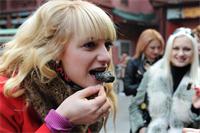
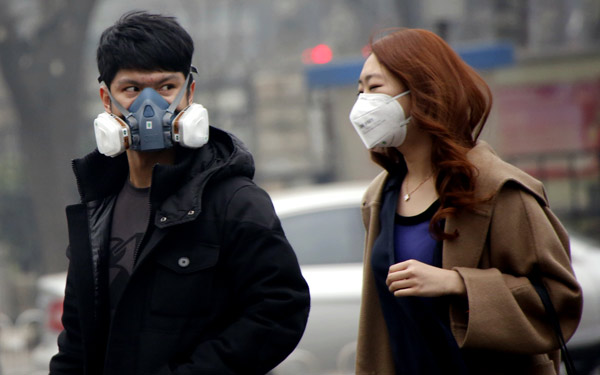
A couple tackle the pollution in a shopping district amid heavy smog after the capital issued its first ever "red alert" for air pollution on Dec 8, 2015. [Photo/Agencies] |
Mount Fuji was obscured behind a perpetual fog of exhaust and particulate matter. Traffic police were equipped with oxygen tanks on particularly hazardous days and many students were treated in schoolyards for inhaling photochemical smog.
This is what Tokyo was in the 1960s.
After World War II and especially during the decades of high-speed economic growth from the 1950s through 1970s, Japan's manufacturers were prodigious, largely unregulated polluters. Japan gained an unenviable reputation as the world's most toxic country. American biologist Paul Ehrlich described Japan as the developed world's "canary in the coal mine", a country so profoundly polluted that it became a test case for how high human tolerance levels could be.
Japan also gave names to some pollution-related illnesses: Yokkaichi asthma, Minamata disease (mercury poisoning)-both named after the cities where they were first detected-and "ouch-ouch" (cadmium poisoning), so called because of the excruciating pain it caused in the bones.
Today, Japan is among the least polluted countries in the world, according to the World Health Organization, and it rightly prides itself on its blue skies, crystal-clear rivers and clean cities and villages.
Thanks to citizens' movements, the Japanese government was forced to fight pollution. Fourteen laws were passed at once in what was known as the Pollution Diet of 1970. The new laws made polluters financially liable to pay their victims, helped resolve disputes, amended and tightened existing regulations on, among other things, air and water pollution, traffic and sound pollution, and toxic waste disposal.
From 1970 to 1975, the Japanese government's spending on the environment nearly doubled in real terms, while local authorities' expenditures increased threefold, and business investment in antipollution measures rose up to 40 percent a year.
Such efforts led to rapid improvements, especially in air and water quality. Japan was acclaimed internationally for its success in pulling back from the brink of environmental catastrophe.
Without sacrificing economic growth, Japan managed to clean the environment by investing in pollution-control technologies and giving local governments leeway to tighten standards beyond national requirements. In 1968, Japan's gross national product reached about $152 billion, exceeding that of what was then West Germany. It became the world's second largest economy in 1978 and held that position until China surpassed it 2010.
The failure to get to grips with pollution is one of the biggest public health failures in the modern history. The WHO warns that air pollution-now the biggest global killer-has serious health consequences.
Japan has set an example for China, whose many regions are often shrouded in thick smog in winter. Especially problematic is PM2.5, particulate matter with a diameter of 2.5 micrometers or less (1 micrometer is one-millionth of a meter). These particulates can penetrate deep into the lungs, causing asthma and bronchitis, and increasing the risk of lung cancer. It is also feared that inhalation of PM2.5 can lead to hardening of the arteries, which in turn can result in myocardial or cerebral infarction. The main sources of PM2.5 in China are automobiles, factories, coal-burning power plants and household heaters that use coal.
If China can lift hundreds of millions of people out of poverty, it surely can find a way to keep its cities' air clean.
China can turn to its neighbor for experiences and technologies to deal with air and water pollution, not least because for the second straight year Tokyo topped the list of the most livable cities in 2016 in the annual Quality of Life Survey conducted by the British lifestyle magazine Monocle.
The author is China Daily Tokyo bureau chief. caihong@chinadaily.com.cn


The year 2016 marks my second time saying farewell to full-time motherhood and back to "normal".
Copyright 1995 - . All rights reserved. The content (including but not limited to text, photo, multimedia information, etc) published in this site belongs to China Daily Information Co (CDIC). Without written authorization from CDIC, such content shall not be republished or used in any form. Note: Browsers with 1024*768 or higher resolution are suggested for this site.
License for publishing multimedia online 0108263 Registration Number: 130349