Demographers find population regulations won't alleviate air pollution
 |
|
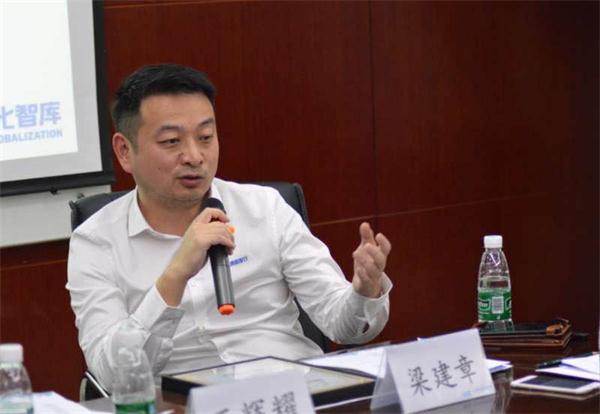
Liang Jianzhang, vice president of CCG and co-founder of Ctrip, gives a speech during a symposium held at the Center for China and Globalization(CCG) , a leading think tank, in Beijing on Jan 6. [Photo provided to chinadaily.com.cn] |
Regulating the population in China's major cities won't alleviate the smog that has been choking northern China the past several months, a leading demographer told a symposium held at the Center for China and Globalization (CCG), a leading think tank, in Beijing on Jan 6.
Liang Jianzhang, a demographer with Peking University, said the opposite is actually true, suggesting that big cities should welcome more rural migrants and further promote service-oriented manufacturing.
Liang, who is also vice president of CCG and co-founder and executive chairman of Ctrip, said most migrants would work in service-oriented industries in big cities if they were accepted.
However, Liang said, if they return home, those people have no choice but to take jobs in labor-intensive steel or iron manufacturing sectors, which worsen pollution. "What matters the most when trying to cut smog is enlarging the level of urbanization."
"Cities and metros are not only leading the way in sustainability, they offer an intrinsically greener, less wasteful and more energy efficient way of life than smaller cities, suburbs and even small towns," Liang added.
Mega cities like Beijing and Shanghai however are stepping up their efforts to control the growth of their population, which results in populations becoming more thinly spread. According to Liang's study, China's mega cities are less dense than their equivalents elsewhere in the world. Given China's GDP per capita, the scale of urbanization in its big cities is still at a low rate, about 20 percent lower than other countries' with similar GDP per capita rates.
Therefore, Liang proposed that the loosening of population restrictions could increase the rate of urbanization, an idea supported by other scholars attending the symposium, including Huang Wenzheng, a demographer with Humanism Economics and a columnist for Caixin.com.
According to Huang, in regards to reducing air pollution, efforts to improve the local economy are far more effective than controlling the population in big cities.
Liang also points out that a high-potential productive population would function as an engine for an innovative economy. Whether in the internet industry, service-oriented industry or entertainment industry, a larger market size in terms of population density leads to a higher incentive for individuals to become entrepreneurs.
"What really happens when you move to a big city is you get to know a lot of people, although they are not necessarily your friends. These are the people who bring different ideas, bring different opportunities and meetings with other great people that may help you," Liang explained.
Another factor mentioned during the seminar is the imbalance in the age structure. "The universal two-child policy could alleviate some pressure, but the fertility rate is predicted to stay low for some time," Liang said.
"A majority of Chinese childbearing-age couples may not be interested in having a second child, especially considering the huge cost of raising children. That's left China staring at a low fertility rate trap."
Liang's report shows that Tokyo's population is about 38 million, more than one-third of Japan's total population. He suggested that the population scale planning of Beijing and Shanghai should be at least 50 million.
"Only letting more workers move into the big cities can bring new possibilities and create economic vitality," Liang said. "Concerns that increasing population size may pose challenges for pollution can be overcome."