Public increasingly confident about Chinese economy
 |
|
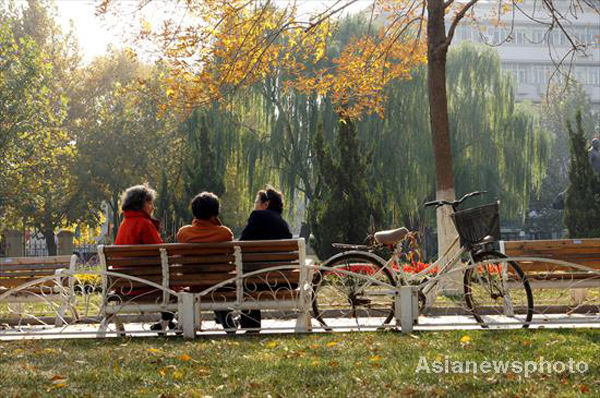
Three retired women chat in a park in Tianjin, Nov 4, 2010. In a research by the Chinese Academy of Social Sciences, during the 12th Five-Year Plan (2011-2015), the population of people over 60 will reach 200 million in China, and the period of 2016 to 2040 will see the population rapidly aging.[Photo / Asianewsphoto] |
Public expectations of the Chinese economy in 2017 remain generally positive and even more buoyant than last year, according to the latest report released by Zijin Media Think Tank, a non-profit organization dedicated to providing information on and analysis of trends in China’s economic situation and social issues.
The report,mainly describes data assessed by?China’s Economic Confidence Index (CECI), results from telephone surveys of people’s expectations of the Chinese economy.
"The index was initially formed against the background that China faced severe pressure from an economic downturn in 2015. As people’s confidence in the economy does really concern both industries and academia, we developed a scale to quantitatively assess respondents’ opinions and expectations on current and trending situations," said Min Xueqin, secretary general of Zijin Media Think Tank, who’s also a professor in the Department of Sociology, Nanjing University, during an exclusive interview with China Daily website.
"We’ve released a series of reports over two years, and given the admiration and recognition shown by the public, the reports will be carried on annually," Min introduced.
The latest report, China’s Economic Confidence Index Report (2016-2017), is based on 4,660 responses from both urban and rural areas of the 13 Chinese cities of Beijing, Shanghai, Shenyang, Tieling, Zhengzhou, Luoyang, Chengdu, Yibin, Nanjing, Suzhou, Xuzhou, Shenzhen and Dongguan, and shows an overall economic confidence index of 58.9, an increase over last year’s 56.68.
When asked what factors contributed to the increase of the index this year, Min said there may be two main causes: first, people have set a healthy pattern of adjusting their lifestyle to the current situation of economic downturn, also known as "New Normal"; they’ve rationally managed their own expectations. Second, various evidence shows that the Chinese economy is about to hit bottom and people are anticipating the rebound.
The questionnaire focused on four areas to explore respondents’ confidence in China’s economy: overall economic situation, employment conditions, total familial income, and willingness to spend.
"The scale is well-developed and could be used for years by collecting the latest samples. Our team adapted international standards when designing it in case we wanted to compare the results with those of other countries. And the samples chosen this year were collected from 13 cities with a rational regional distribution within the whole country," Min explained on the rationality of applying the scale and sample collection.
The researchers are keen to highlight several findings in this year’s report:
First, the overall data shows people are optimistic about current conditions and future prospects of the economy.
Second, residents in second-tier cities are more confident about the economy than those in first and third tier cities. The overall economic confidence index in second-tier cities such as Nanjing, Suzhou, Chengdu, Zhengzhou, and Shenyang is 59.26, higher than the first-tier cities’ 58.98 and the third-tier cities’ 57.94. This could be the result of the rapid economic growth of second-tier cities and their less stressful environment.
Third, the middle class is generally "conservatively optimistic" about China’s economy, with an overall economic confidence index of 58.89, slightly higher than the low-income group’s 56.58. Particularly, the survey result shows that middle-income people are relatively pessimistic about their own economic and employment conditions while appearing to be far-above-average optimistic when asked about their family income and willingness to spend. In contrast, the low income group shows the opposite tendency.
Fourth, respondents tended to have a more positive attitude about employment conditions in 2016 than the year before, but still showed pessimism in evaluating their economic conditions, family income and willingness to spend.
Fifth, the elderly and people under 30 hold a positive view of the economy, while the middle aged group may have less confidence.
Sixth, residents are spending increasingly on personal development and recreation, including education and tourism.