Trump's trade agenda, a double-edged sword
 |
|
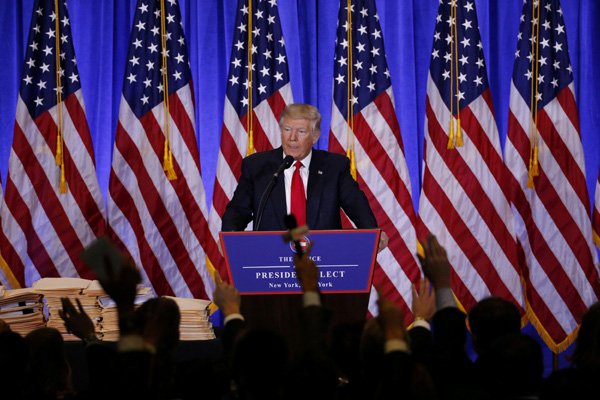
US President-elect Donald Trump speaks during a news conference in the lobby of Trump Tower in Manhattan, New York City, US, January 11, 2017. [Photo/Agencies] |
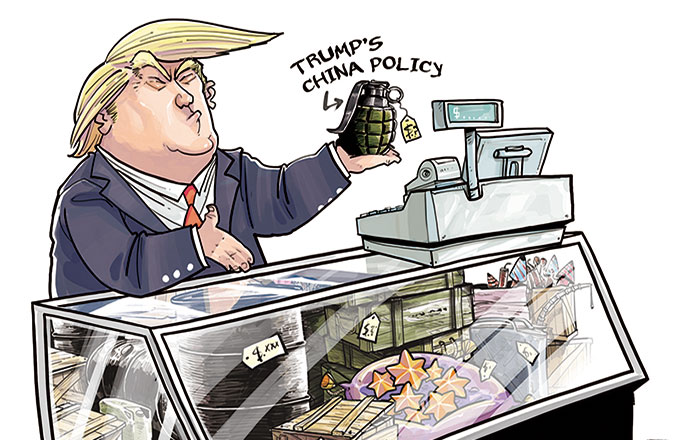
With US president-elect Donald Trump's inauguration approaching, it worries many that his ambition and stated potential actions to revive US manufacturing and employment may heighten trade frictions with China.
Not only has he accused China of "stealing jobs away from Americans", he has also nominated a number of trade hawks known for wanting to play protectionist cards against China to form a new National Trade Council.
He has handpicked Peter Navarro, a noted China critic as his new director of trade and industry policy, and Robert Lighthizer, former deputy trade representative in the administration of Ronald Reagan known for waging a trade war with Japan, as the US trade representative.
Trump and his team of outspoken China hawks could spell escalated tensions in China-US trade exchanges. And, as the Peterson Institute for International Economics in Washington has said, a trade war is not impossible should the new US president carry through campaign promises such as the one to impose a 45 percent import tariff on Chinese goods. That warrants high vigilance from both countries as a trade war would have devastating effects on bilateral trade ties.
The odds are increasing that China's steel industry will be the first target and victim, as Trump has made several hardliners in the industry his economic advisers. That means Chinese steel exports may face stricter anti-monopoly and anti-dumping investigations by the US, even tariff-related discrimination, highlighting the need for Beijing to push forward reduction of the country's excessive capacity and the upgrading of its manufacturing.
Also not good news for China, which has made more direct investment in the US than the other way round for four consecutive years as of 2015-a trend that is likely to continue in the years to come-as well as threatening US companies that deploy factories overseas with punitive tariffs, Trump is attempting to lure them back with favorable tax policies.
However, the incoming administration should bear in mind that Chinese businesses have already made big investments in the US that have played a significant role in the US economic recovery and created jobs for Americans, and most US states are involved in some kind of business with China.
At the same time, with China-US trade exchanges being over-politicized as a bargaining chip in the overall bilateral ties, the internationalization of the Chinese currency and Beijing's efforts to rein in capital outflows could hit a speed bump.
Strategic competition is on the rise between the world's largest and second largest economies especially when it comes to cross-Straits issue, South China Sea disputes and global governance. Known for taking risks in his business career, Trump is not likely to give up touching upon the one-China principle in a provocative manner, in the hope of gaining economic concessions from China.
Amid heightening tensions and uncertainty, China will have to make its own moves to put the bilateral relationship back on the right track. The first is pursuing dialogue. Established cooperative mechanisms like the annual China-US Strategic and Economic Dialogue could well serve the mission to reduce trade frictions and deepen cooperation.
The dim prospects for the Trans-Pacific Partnership agreement could give China an opportunity to proceed with the Regional Comprehensive Economic Partnership, backed by ASEAN, as well as the China-US Bilateral Investment Treaty, without dampening its ties with other major economies.
To sum up, both courage and caution are required from Beijing if it is to secure an advantageous position in global trade and investment competition.
Li Wei is a researcher at the National Academy of Development and Strategy at Renmin University of China, and Zhang Yuhuan is an associate researcher at the China Institute of International Studies.