Little for US to gain from a trade war
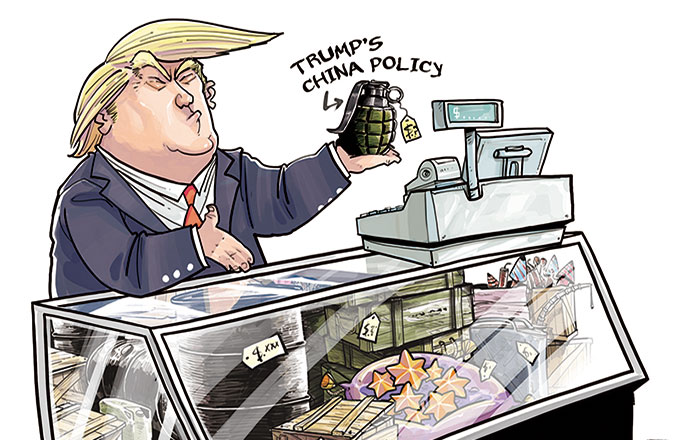
Will there be a trade war between the world's two largest trading powers? Anxiety is spreading among business people around the world as the Trump administration takes office in the United States, with many saying a showdown with China is unavoidable and imminent.
In his inauguration speech on Friday, Donald Trump signaled no retreat from his populist agenda on trade, immigration, and on scaling back commitments overseas.
"Every decision on trade, on taxes, on immigration, on foreign affairs will be made to benefit American workers and American families. We must protect our borders from the ravages of other countries making our products, stealing our companies, and destroying our jobs," he said.
If he means what he says, then how many regular business ties will be affected? No one can tell. However, Chinese businesspeople can use this moment to reflect on what they have to lose and gain from a trade war, if one does materialize.
First, what they will lose? If there is a hike in tariffs across the board, then Chinese companies will lose a lot of orders for the same goods they have been shipping to the US market for the last decade.
What will they gain? Some of these goods are made from imported materials, like iron ore, and actually don't sell for much of a profit. And environmentally, they may even produce a negative value. Officials with China's National Development and Reform Commission may thank the Trump administration if it can help China offload obsolete, unsustainable industrial capacity quicker.
Chinese business executives, at the same time, may use the opportunity to apply for more tax breaks and preferential policies and turn to producing more competitive products. With the right policy incentives, China's ample savings can be used for a new round of industrial investment.
Now is a good time for China to upgrade its industry – with some 7 million college graduates (more than half of its total new labor) joining its labor market each year.
The rise in labor costs, at the same time, no longer permits the kind of production widespread in China in a decade ago.
Second, what will be the reaction? No war can be one-sided. The Chinese government will adopt counter-measures, and local companies will find more import substitution opportunities in the selected industries.
And if a real war is waged alongside a trade war, that will only create more defense orders for local companies.
Third, what cost will the war-maker will bear? Every war comes with a cost. And trade wars backfire easily, especially for a more advanced economy. If heavy protection is required for US manufacturers to make the same goods as can be made equally well in China or in Mexico, then it will hurt, rather than benefit, the competitiveness of the US economy.
A temporary protection may be needed, admittedly, for workers to swop jobs and companies to turn out new products. But long term, it is a dose of poison for entrepreneurship.
In the future world market, US companies cannot compete by making the things that can be made in many developing countries. Even Chinese companies can't afford to think that way, now that its wages are above some other Asian countries.
In what areas the US economy will enjoy future competitiveness is for US leaders to point out.
Fourth, the war-maker will inevitable make a loss: A trade war will also backfire because it will turn away potential customers in a country with a population of 1.3 billion. Many international brands have benefited from their sales to China. It would be foolish to deny US brands the opportunity to do the same.
Last, what is the purpose of a trade war anyway? If it is for China to buy more Made-in-the-US products, then why must anyone, especially anyone calling himself a businessperson, engage in a trade war? What real businesspeople should do is negotiate to strike the best deal they can.
Indeed, since Trump was quoted as having said everything is negotiable, what's the point of a trade war?
The author is editor-at-large of China Daily. edzhang@chinadaily.com.cn