Toilets tell a tale of changing times
 |
|
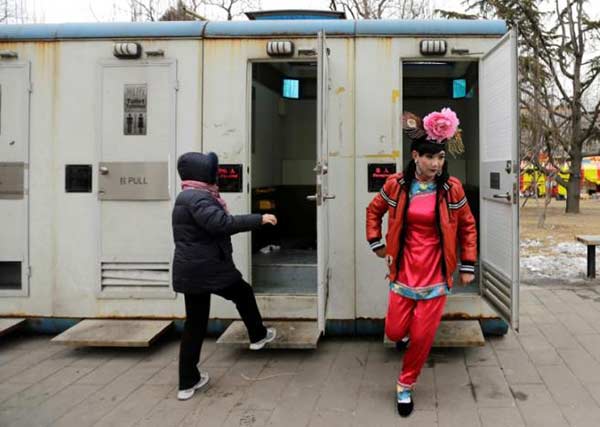
A male folk artist (R) dressed as a traditional Chinese woman walks out of a mobile toilet ahead of a performance at a Spring Festival Temple Fair on the fifth day of the Chinese Lunar New Year at Longtan Park in Beijing, Feb 14, 2013. [Photo/Agencies] |
The first time I encountered a high-tech toilet, in a luxury hotel in Chengdu, Sichuan province, Southwest China, it was as unexpected as an apparition. As soon as I opened the door to the toilet cubicle-opening the door was the only thing I had to do manually-I was greeted by an intimidating, supersized toilet. Then there was a whirr and the toilet cover opened automatically. I sat down on the pleasantly heated seat. To my right I noticed a panel with half a dozen buttons and pictograms, so I experimented-there were buttons that squirted a jet of water for washing the nether regions, front or back (the strength of the squirt could be modulated by other buttons), a button that let out warm dry air after washing, buttons for adjusting the temperature of the toilet seat, a button for an extra flush (that's because the toilet automatically flushed as soon as you stood up). Each of the operations had its own distinctive sound.
Automated toilets are indeed mostly popular in East Asia. They are ubiquitous in Japan, where they are found even in public toilets in the cities, and these automated toilets hit the news recently when Japan announced that for the sake of foreigners, especially given the expected influx of visitors for the 2019 Rugby World Cup and the Olympic Games the year after, the buttons in new toilets will be standardized and have simplified pictograms and English-language translations. Small measures aimed at making the automated toilets less disconcerting to foreigners.
As China takes to these automated toilets, it should follow Japan's lead in standardizing the pictograms and labels, putting labels in Chinese and English. At present they are only found in some hotels and wealthy people's homes in China, but judging from their availability in shops that sell bathroom fittings even in small cities in China, these toilets are likely to become common as China prospers. And adding standardized pictograms and English labels at the production stage would serve to take the mystique from these toilets for the uninitiated.
These toilets have such a robotic spell to them that they become like companions once you get used to them. I especially liked sitting on a warm seat, and it took the effort out of washing the nether regions. One of the reasons why these toilets are unlikely to catch on in the West is because Westerners do not usually wash after using a toilet, as opposed East (and South) Asians, most of whom do.
When I was decorating my apartment in China, I considered installing a high-tech toilets in my flat. But the price was sobering-prices started at 5,500 yuan ($799), a decent normal toilet cost about 1,500 yuan-I was further put off by the amount of electricity consumed and the costly repairs that might ensue if there was later any faults in the digital operating system. Besides, the space in my bathroom is limited. So I decided against it in the end, and took consolation from the fact that my toilet was still decent, about halfway between the cheapest and the expensive high-tech ones. And in a country where rapid development has led to contradictory juxtapositions-using a high-tech toilet in the city one week, and squatting over a hole in the ground at an isolated peasant's farmhouse in the mountains a week later-I was content with what comfort I had secured for myself.
The author is a freelance writer who specializes in culture, travel and lifestyle.