Emerging innovation powerhouse with new patent policy
 |
|
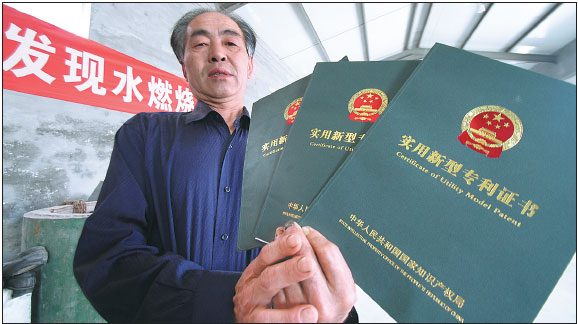
A senior inventor shows his official patent certificates for his innovations in boilers. Facing a growing number of patent filings, the State Intellectual Property Office is working to speed up its processing process.[Photo provided for China Daily] |
Some recent headlines claim Chinese companies overwhelmingly "don't innovate", "lack creativity" and with the help of the Chinese authorities are "thieving" US intellectual property. They also claim the new administration in the United States has vowed to tackle this "massive theft".
But other headlines state China is a "top innovator" because it receives the most patent applications of any country and that the Chinese government strongly supports this growth through strategic planning.
These disparate narratives suggest that China's patent policy has either failed to make China an innovative country, or it is already an innovation powerhouse.
The fact is, China is not yet a top global innovator, although it is innovating, is serious about protecting IP and is strategically advancing in these areas. As such, the new US administration should look beyond misleading headlines and develop a nuanced policy response to these shifting dynamics.
China is the world's leading filer of domestic patent applications and it has significantly contributed to this accomplishment by providing various incentives for patenting. However, the quality of many of China's patents, and therefore the extent to which they represent true innovation, has come under scrutiny in recent years.
In response, the Chinese government has proposed a series of important guidelines and plans in the last three years to better incentivize quality patents. These include the recently issued National Intellectual Property Development Strategy which sets ambitious targets to stimulate valuable patents (alongside its target for every 10,000 people to own 14 invention patents by 2020). It says, for example, 2 trillion yuan ($291.4 billion) in technology contracts should be registered and $8 billion in export income from royalties and franchising fees should be accrued from Chinese IP by 2020.
China has also developed a range of initiatives attempting to better encourage usage of inventions, recognizing the significant gap between patenting and commercialization. For example, the latest draft revision to the patent law adds an entirely new chapter of instruments to facilitate patent commercialization.
Although China experiences many IP rights infringements, IP laws are generally enforced in the country and the government is seriously improving IP protection. China is home to more patent lawsuits than any other country but also has relatively strong institutions for reasonably adjudicating these disputes. And not only foreign companies enforce IP protection in China. In fact, in part because their innovation capabilities, many Chinese enterprises have grown to a critical level where they need IP protection as much as foreign companies. Most of the IP lawsuits in China (more than 98 percent) are between domestic companies, not between foreign and domestic enterprises.
Moreover, in the last few years, the Chinese leadership has made improving IP protection a national priority. In 2014 and 2015, the first specialized IP courts in China were established in three major cities (in addition to the many IP "tribunals" already in place throughout the country), making China part of a limited number of countries to have such a mechanism. Plus, there have been an incredible number of recent legislative changes improving IP protection, including dramatically increasing statutory damages that courts can award for IP infringement. And foreign companies today generally win their IP cases in Chinese courts.
Also, in the last three years, the Chinese authorities have significantly strengthened regulation of abuse of patent monopolies and proactively enforced these new rules.
What does this mean for the US?
Supported at least partially by the State, the likely increase in the quality of Chinese patents should better foster innovation, which will create collaborative opportunities and a wealthier consumer base from which foreign companies can profit.
At the same time, these developments will increase competition. Also, stronger IP institutions and new IP laws will enable some Chinese enterprises to better litigate against their foreign counterparts. And new regulations will restrict certain IP monopolies.
These dynamics show that China's IP and innovation capabilities, and the State's role in building them, cannot be distilled into the simplistic media headlines currently dominating some discourses. Instead, they present more nuanced challenges and opportunities.
Of course, the US authorities should continue their productive work engaging China on IP protection. But the sooner the new US administration realizes that China in fact can innovate, the faster American policymakers can respond to reality. That will allow the US to craft the type of foreign and domestic policy needed to keep America competitive in a changing world where China, too, may eventually be an IP and innovation powerhouse.
The author is a research collaborator at the GLORAD Center for Global R&D and Innovation, Tongji University, Shanghai.