 |
|
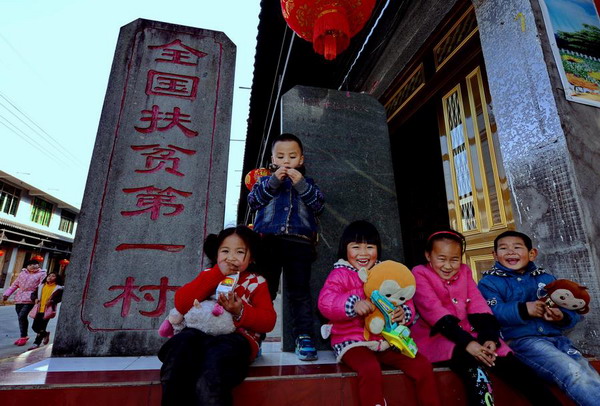
Children of She ethnic group sit in front of a monument that reads "China's No. 1 Poverty Relief Village" at Chixi Village, Panxi town, Fuding city in East China's Fujian province, Feb 14, 2016. The village has shaken off poverty thanks to assistance from Party and government officials at all levels over the past 30 years. [Photo/Xinhua] |
While growing up in a village at the foothills of a mountain in Southwest China's Sichuan province I would stare at a truck or a bus when it passed by on the only bumpy road that led to the outside world. I always dreamt of planes flying overhead every day, but in those days one was lucky to see even one in a month. Those were the days when the villagers used oil to light their lamps and lanterns, because there was no electricity. The village was connected to a power grid just before I enrolled in a university in the early 1990s.
Tremendous changes have taken place since then, though my mountainous county-Tongjiang-is still listed as one of the poorest in China.
Many laborers have migrated to cities to work on construction sites to support their families. And some students, thanks to easier access to higher education, have found decent jobs in cities after graduation. But despite these changes, a number of villagers are still leading a difficult life. And nationwide, more than 40 million people share their plight.
The good news is that President Xi Jinping has vowed to lift all of them out of poverty by 2020.
The national leadership's measures to alleviate poverty are effective. For instance, it has bound every poor family in a "partnership" with a grassroots civil servant tasked with the responsibility of lifting it out of poverty. The campaign, rightly called the "precise poverty-alleviation strategy", is high on the government's agenda.
In addition to the "partnership" strategy, China is also putting the experiences it has gained since the 1980s in lifting 700 million people out of poverty into practice.
Recently, three pieces of news have created excitement among residents of my village. By 2018, a highway will cut through the mountains, which are just 3 kilometers from my village, and the local government has decided to invest $100 million to clean the polluted river running close to the village, plant more trees in the mountains and rebuild the small town on the river.
But the most exciting news is that a small airport will be built in the next two years near the mountainous village, which will fulfill my childhood dream of seeing planes fly by every day. As the first airport in my county, it will be used by commercial and private aircraft, as well as for disaster-relief work and other emergency purposes.
A bigger airport in my neighboring county is already under construction and will start operations by 2018. When I conveyed this news to my friends, they too were overjoyed. But some asked: Is it necessary to build two airports in such close proximity?
Tongjiang county is part of Bazhong city, which has a population of about 4 million-or half of Sweden's and one-third of Belgium's populations. And Sweden has more than 100 airports of various sizes.
This comparison is important. An important personality whom I interviewed in a snowy village in central Switzerland in January flew on her private plane from Zurich to meet me. European countries have set an example for China to follow. Consistently improving the infrastructure in poor and remote regions means faster economic development.
Once the road and airports are built, residents of Bazhong and nearby cities can reach Xi'an, Chengdu or Chongqing-the three biggest cities in the western part of China-within an hour by plane, or three to four hours by car. This was only a daydream even a couple of years ago.
Better infrastructure will help attract investors from home and abroad, and their investments will boost agriculture, education and tourism sectors. As such, the national leadership's new poverty-alleviation strategy will connect not only villages in Tongjiang but also other places to the chain of global economic development and the people now living in poverty will soon see their fortunes change.
The author is deputy chief of China Daily European Bureau.
fujing@chinadaily.com.cn



Copyright 1995 - . All rights reserved. The content (including but not limited to text, photo, multimedia information, etc) published in this site belongs to China Daily Information Co (CDIC). Without written authorization from CDIC, such content shall not be republished or used in any form. Note: Browsers with 1024*768 or higher resolution are suggested for this site.
License for publishing multimedia online 0108263 Registration Number: 130349