Role of top political advisors in policymaking
 |
|
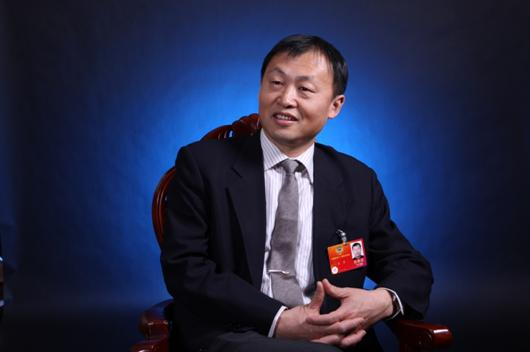
Wang Ming, member of the Chinese People's Political Consultative Conference from Tsinghua University. [Photo provided to chinadaily.com.cn] |
All members of the Chinese People's Political Consultative Conference National Committee, the country's top political advisory body, expect their proposals to play a role in policymaking. Over the past two decades, proposals from members of the National Committee of the CPPCC have tripled. Back in 1993, when the first session of the 8th CPPCC National Committee was held, the members submitted about 2,000 proposals; the figure increased to 5,000 in 2008 and has remained steady at around 6,000 since 2013.
This may prompt the public to ask the question: How many of these proposals evoke a response from the central government? And what kind of proposals are taken into consideration while making policies?
Most proposals from CPPCC National Committee members get responses from related executive government agencies, and some eventually lead to legislation.
Take my own experience for example. About 10 percent of my proposals in the past 15 years have been considered while formulating policies, some of which have already come into force. My proposal to allow all couples to have two children, which many other CPPCC National Committee members also voiced, eventually became a national policy.
Apart from being included in policymaking, such proposals can also affect public opinions and thus help reach a social consensus on a specific issue with the support of the media. This is a very important role proposals submitted to the CPPCC National Committee play, yet we don't pay enough attention to it.
One point needs to be made clear here: in most cases, it's not an individual's proposal that leads to a policy. Only when a proposal represents the needs of the majority of the people and promotes public interest will the CPPCC National Committee thoroughly discuss it. And only if the policymakers reach a consensus that the proposal enjoys enough support among the public can it be transformed into a policy. The agencies and departments of the State Council, China's Cabinet, for instance, realized the two-child-per-couple proposal enjoyed social consensus and only then gave a green light to the policy.
I always upload all my proposals, along with explanations, on my blog during the annual sessions of the CPPCC National Committee and the National People's Congress, the country's top legislature, so that journalists can better understand them and disseminate them among the public. It's important to explain the proposals and their applications to the people, because their response will help us better formulate our proposals.
Step by step, I have realized the process of formulating a proposal is more like carrying out a systematic project. First, you need to raise a pertinent issue at the CPPCC National Committee session. Then you conduct a survey to collect more data and analyze all the available information. Finally, you submit a written proposal to the relevant department and wait for its response. So the process is more like research work.
Some CPPCC members lack the art of using a proposal as an important tool, while some don't know how to raise issues that people actually care about. CPPCC members have the responsibility to take care of people's needs, by definition their position is political.
As the last annual session of the 12th CPPCC National Committee opens on Friday, it offers the CPPCC members the chance to summarize their proposals and ideas over the five years. They need to use this opportunity and see submitting proposals as a really valuable political, economic and social duty. Using the proposals as a powerful tool that influences policymaking is very important in these times when our country progresses toward comprehensive and deepening reforms.
The author is a member of the 12th National Committee of the CPPCC, and vice-dean of the School of Public Policy and Management, Tsinghua University. This article is an excerpt from his interview with China Daily's Wu Zheyu.
- The issues that concern you most during 'two sessions'
- How the two sessions have changed China
- Blue skies in Beijing to greet two sessions
- Xinhua Insight: China's two sessions to highlight Xi's thoughts
- Two Sessions Special
- Two Sessions welcome foreign reporters
- Two sessions media center up and running