China and TPP are not made for each other
 |
|
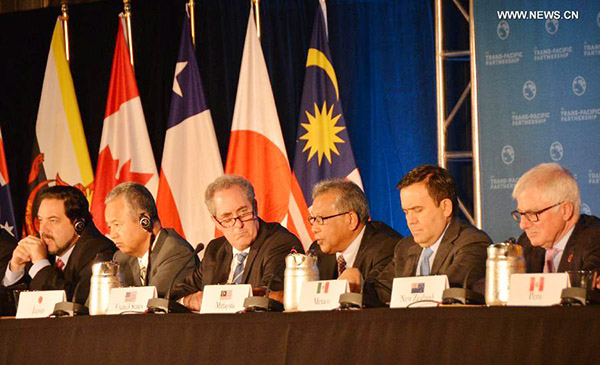
Trade ministers of the United States and 11 other Pacific Rim countries attend a press conference after negotiating the Trans-Pacific Partnership (TPP) trade agreement in Atlanta, the United States, on Oct 5, 2015. [Photo/Xinhua] |
Last Friday, the Ministry of Foreign Affairs said China is considering sending a delegation to the Pacific Alliance dialogue in Chile, which will also be attended by the countries that signed the Trans-Pacific Partnership agreement. The announcement was misinterpreted by some media outlets to mean that "China is preparing to join the TPP", sparking discussions at home and abroad. The ministry finally cleared the confusion on Monday.
Even though China's Special Representative on Latin American Affairs Yin Hengmin participated in the two-day dialogue starting on Tuesday in Chile, it doesn't signal China will join the TPP. The Pacific Alliance is a regional economic organization established by Chile, Peru, Mexico and Colombia in 2011. Chile, the rotating presidency of the economic alliance this year, invited the signatory countries to the TPP, China and the Republic of Korea to attend the meeting as it was aimed at creating opportunities and meeting the challenges in the integration of the Asia-Pacific region.
China is not averse to the idea of the TPP. But since the TPP is not in line with its interests, the chances of China joining it are remote. Although the meeting in Chile included discussions on TPP-related topics, it had many other subjects on the agenda. That a four-country economic alliance can expand to its current scale is a testimony to Chile's diplomatic success, and the failure of the TPP to influence the signatory countries. And China's presence at the meeting shows its constant support for the regional economic integration of the Asia-Pacific region.
Even after the United States, which initiated the TPP, withdrew from it, China's stance on the trans-Pacific economic arrangement has not changed despite Australia and some other TPP signatory countries' wish to see China fill the vacuum created by the US' withdrawal. The TPP lags far behind the General Agreement on Tariffs and Trade or the World Trade Organization in terms of their scopes.
China started working on the possibility of joining the GATT after former US president Richard Nixon's ice-breaking visit to Beijing in 1972. It continued its efforts to join the GATT/WTO during the 1980s and 1990s, and ultimately became a WTO member in 2001, which widened its reach in the global economy.
In comparison, the TPP is only a regional economic agreement and the number of its signatory countries is just a fraction of the WTO's. And because of the US' withdrawal, the gap between the TPP and WTO has widened further.
Those who speculate China could join the TPP refuse to accept the real state of the global economy. China is already the world's largest exporter and second-largest importer, and it cannot expect to gain much by joining the TPP. Moreover, the TPP is not a high-level free trade agreement, as some US experts want us to believe, because it is full of content that violates basic economic rules.
Add to the fact is, partially at least, part of the US' "pivot to the Asia-Pacific" strategy that has no place for China. So it is absurd to assume China will swallow all those bitter pills and agree to join the TPP.
The TPP is a typical example of the many international trade arrangements and rules that Western countries dominate. Such arrangements and rules have too many articles that reflect Western "values" at the cost of economic fairness.
The Trump administration's withdrawal from the TPP and its plans to ease domestic controls, and loosen financial supervision and medical care insurance are all signs that the US economy is out to fight against restraints.
But China has no reason to invite new shackles in the form of TPP membership to suffocate its trade. Therefore, any conjecture on China joining the TPP is nothing but wishful thinking.
The author is a researcher at the International Trade and Economic Cooperation Institute of the Ministry of Commerce.