Globalization: Not over, but at crossroads
|
 |
|
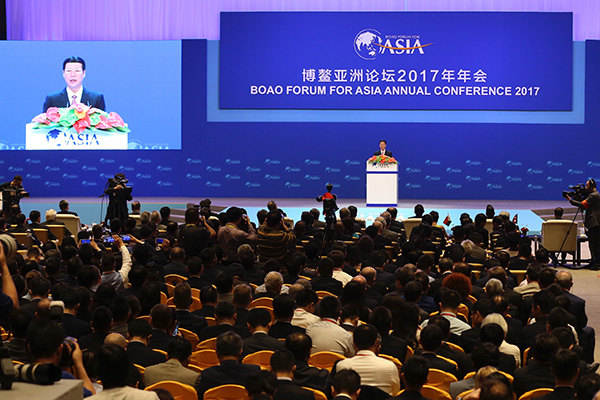
Chinese Vice-Premier Zhang Gaoli delivers a speech at the opening ceremony of the BFA Annual Conference 2017 in Boao, South China's Hainan province, March 25, 2017. [Photo by Feng Yongbin / China Daily]? |
It’s been more than two decades since the world witnessed far-reaching political and economic changes that institutionalized a new world order and advent of economic globalization. These include the disintegration of the erstwhile Soviet Union, the German reunification, global endorsement of market-based structural reform policies as advanced by the ‘Washington Consensus’ and the establishment of the WTO. The growth of a unipolar world order dominated by the US and its military partners mostly from Europe was accompanied by aggressive trade liberalization championed by WTO. In this respect, the 1990s consolidated the neo-liberal economic policies introduced by the UK and US in the 1980s. The establishment of economic globalization in the last decade of the previous century marked the success of Western leaders and institutions, including the IMF and the World Bank, in carrying forward an economic agenda that would maintain the global economic command of the OECD countries.
The remarkable economic growth of China, its joining the WTO, and the success of developing countries in bringing on the Doha Development Agenda posed major challenges to the ongoing process of economic globalization. The West soon began realizing the reluctance of various developing countries, such as China, India, Brazil and South Africa, in accepting trade liberalization the way the West wanted. The reluctance soon took the form of organized coalitions at the multilateral trade meetings of the WTO. With opinions sharply split between developed and developing countries, the WTO could no longer carry forward a multilateral trade program that would create level playing fields for all countries. From 2008 onward, the US lost interest in the WTO and initiated the Trans-Pacific Partnership for achieving trade liberalization through regionalism. This consolidated the growth of regionalism that was already visible in various parts of the world, particularly Europe and Asia, where frustration over lack of progress in WTO had encouraged growth of bilateral and regional trade agreements.
The advent of regionalism marked a setback for globalization as lack of multilateral efforts for taking forward globalization slowly receded. Regionalism could hardly have produced the opportunities for all countries of the world as multilateralism could have. Indeed, many countries from the relatively more underdeveloped parts of the world could not respond to regionalism as effectively as many others, particularly from Asia and Europe could. But at the same time, the relatively more economically backward countries continued to benefit from the access they had obtained from the WTO in global markets. The Least Developed Countries (LDCs) benefitted from duty-free quota-free access their exports got in developed country markets. Several developing countries also benefitted significantly from increasing fragmentation of global value chains that saw their labor forces handling a large variety of global manufacturing and they becoming locations for assembling and processing of hi-tech manufactured items. At the same time, primary commodity, or resource exporting developing countries benefitted from the high demand of their products in rapidly growing emerging markets in Asia, primarily China, which pushed aggressively on domestic infrastructure development.
The West lost almost its entire credibility in leading globalization after the financial crisis of 2008. Several Western states lost their abilities to push globalization and regionalism by funding projects in foreign locations as their businesses ran out of surpluses. Failed banks could no longer lend to businesses for funding investments as they had done earlier. As firms closed operations and jobs vanished, two prominent reactions were visible. The first was the realization that Western enterprises, institutions and funds could no longer be the engines for global growth, trade and globalization. The realization was accompanied by serious doubts over whether the West’s way of championing globalization was indeed the right way. While these were reactions surfacing in countries across the world, rich or poor, the more severe reaction was experienced in the Western countries themselves. Upset over loss of jobs and the ability to lead a ‘good’ life, angry citizens debunked globalization for all their miseries. The backlash found its political expression in Brexit and the latest US elections.
Globalization today stands at a critical juncture. Opponents of globalization find it a convenient excuse for defending their circumstances, which are results of poor public policies and lack of foresight. But on the other hand, globalization has produced considerable benefits for many in the world. These include the poor countries where livelihoods and living standards of many have improved from their access to trade and global markets. It is important for these beneficiaries of globalization, from China and other developing countries, to counter the anti-globalisation narrative.
The author is Senior Research Fellow at the Institute of South Asian Studies in the National University of Singapore.