After Article 50, May can divide and deal
|
|
|
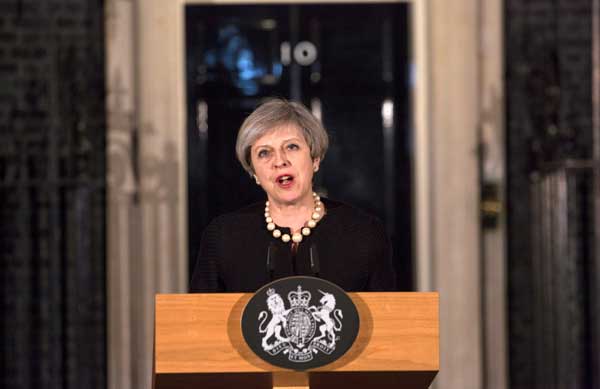
Britain's Prime Minister Theresa May makes a statement at Downing street in London, Britain, March 22, 2017 following the attack in Westminster. [Photo/Agencies] |
European history will be made this Wednesday as British Prime Minister Theresa May formally triggers Article 50 - the clause in the Treaty of Lisbon enabling a European Union member state to exit the 28-member bloc.
After the shock referendum result last June, the UK underwent months of political uncertainty as May’s government debated its position for the Brexit negotiations. However, after the government set out some of its aims last month, the UK’s position is now becoming clear. With membership of the EU’s single market and customs union ruled out, the prime minister is aiming for a clean break with the EU. And everything will be on the table.
Yet nearly all the focus since the referendum has been on the UK, and in particular the prospect that it might be forced to pay a heavy price for leaving the EU. Well, maybe.
But when one considers all the issues that member states have fallen out over in the past few years - from the migrant crisis to financial regulation - things start to look a little more complex.
Member states are currently less united regarding the future of the bloc than at any point in recent times.
One big development is the strength of Euroskeptic feeling within member states. There is much talk of a French, Greek, Swedish, Hungarian or even Dutch exit from the bloc. This will leave the EU with a difficult dilemma - try to punish Britain and inflame Euroskeptic opinion, or give the UK more of what it wants, at the risk of emboldening Euroskeptic voters in member states.
Early on in the negotiations, the issue of EU nationals resident in the UK, and UK nationals resident in the EU will come up. May’s government has signaled it is willing to use the 2.9 million EU nationals living in the UK as a bargaining chip in the negotiations. This will be a difficult issue for member states to find a common negotiating position on. Members such as Spain, home to a significant number of British nationals, may not wish to guarantee the rights of Britons living in the EU. On the other hand, the eastern member states, especially Poland and Romania, will be very keen to secure the rights of their nationals living in the UK.
Some EU countries have especially complex issues with Britain’s divorce from the bloc, which will have to be incorporated into the EU’s negotiating position if it’s to remain united. Both Spain and Ireland share a border with the UK. Whatever arrangements get made for their borders will be complex to negotiate, yet if it comes to it, can the EU really allow the specific interests of two member states to outweigh those of its other members?
If May’s government really is putting everything up for discussion, then the EU will have to think carefully about its security cooperation with the UK. British military capabilities and intelligence gathering are the best in Europe - will Britain’s NATO membership be enough for the bloc, or will it feel the need to keep Britain cooperating more closely?
On trade, having access to the EU’s single market is certainly important for British industry, but the EU sells more to the UK than the UK buys from member states - May can and should use this to her advantage. At a time when the bloc is the slowest growing region of the world, it should be possible to persuade it that to not offer Britain a favorable deal will further harm the economies and thus the poorest workers of member states, further fuelling the Euroskepticism that is tearing the organization apart.
One of the most interesting developments in the bloc in recent years has been the gradual emergence of an “internal opposition” - governments that are either opposed to further integration or are willing to outright defy the authority of Brussels, in particular Poland and Hungary. If the main EU states have agreed a negotiating position that is not in the UK’s interests, then May’s government can attempt to split the bloc by appealing to countries that oppose aspects of the organization.
Nothing about the Brexit negotiations will be easy, but the notion that the EU somehow holds all the cards is nonsense. When Greenland left in 1985, the process was relatively simple, since the territory’s only industry was fishing. But this time the EU will be negotiating with a country that has the world’s fifth-largest economy, significant defense and security assets, and real influence in the world.
If May’s government can exploit divisions and play a hardnosed game of realpolitik, there is a good chance she can negotiate a divorce on terms favourable to Britain. This outcome would of course be a major blow to the EU - a country will have successfully left the bloc, having further exposed its divisions and weaknesses.
One thing is certain, on the 60th anniversary of the Treaty of Rome, the organization is in mortal danger.
James Skinner is a contributing editor at China Daily with an MA in International Relations. He has a particular interest in British and American politics, as well as global security issues.