US, DPRK must hold talks before it's too late
 |
|
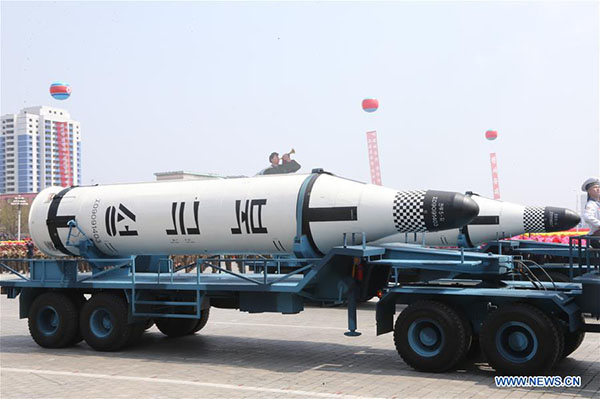
A submarine-launched ballistic missile is displayed during a military parade in central Pyongyang, April 15, 2017. [Photo/Xinhua] |
Among the possible, but the least desirable, responses to the Democratic People's Republic of Korea's nuclear and missile tests (although its last one on Sunday was a failure) could be a preemptive strike by the United States. There is no guarantee, though, that the presumed US strike would be precise enough to wipe out all nuclear facilities in the DPRK before Pyongyang launches a nuclear attack in retaliation.
If that happens, the DPRK won't wait to fire its nuclear missiles, and thousands of howitzers and rocket launchers deployed along the 38th parallel Military Demarcation Line into the Republic of Korea. No defense systems, including the US Terminal High Altitude Area Defense anti-missile system, will be able to shield off such a shower of artillery shells. And Pyongyang's missiles could destroy Seoul and hit even Japan.
Since 2006 the United Nations has passed a number of resolutions imposing sanctions on the DPRK. The ever-tougher sanctions have crippled the DPRK's economy but failed to rein in its nuclear and missile programs, revealing an intrinsic loophole in any economic sanction: they are meant to harm the leader or ruling party but, instead, always end up hurting innocent citizens first and most, leaving the real target to suffer the effects, if at all, last.
Talks are the only way to resolve the issue. But how can the US be persuaded to hold talks with the DPRK? Having fired 59 Tomahawk missiles on Syria on April 6, the Donald Trump administration seems anxious to use force to showcase its political resolve. The US doesn't want to be seen as being blackmailed by a country it has labeled a "rogue state". That is why Washington has rejected all proposals by Pyongyang for bilateral talks. Besides, it believes that the Six-Party Talks were useful only in giving the DPRK the needed time to develop nuclear weapons.
But time is running short. DPRK leader Kim Jong-un said in his New Year's Day address that his country was close to testing an intercontinental ballistic missile which would bring the US within its range. Although Pyongyang has suffered many failures in missile tests (like the one on Sunday), if it can, even theoretically, develop medium range missiles, it can build ICBMs one day. In fact, Pyongyang exhibited two ICBM-size canisters for the first time at a parade on April 15, the 105th birth anniversary of the DPRK founder Kim Il-sung.
But why would the DPRK want to develop nuclear weapons? A short answer is: for survival. Its worst fear is a preemptive strike by the US to effect a regime change. Unless attacked, there is no reason why the DPRK should launch a suicidal attack against the ROK. Pyongyang is desperately trying to develop ICBMs because it believes, however wrongly, that if it possesses missiles that can reach the US, its survival would be assured.
Therefore, the first step toward denuclearizing the Korean Peninsula is to reduce the importance of nuclear weapons for the DPRK. For that to happen, the US needs to convince Kim Jong-un that it has no plans to launch a strike on or engineer a regime change in the DPRK. Indeed, US Secretary of State Rex Tillerson has said the Trump administration has no plans for engineering a regime change in Pyongyang, but apparently the deployment of US warships in the region sends a different signal.
That is why China's proposal of suspending hostilities is worth considering. Beijing has suggested that as a first step, the DPRK freeze its nuclear program if, in exchange, the US halts its military exercises with the ROK. The proposal is balanced in that it doesn't ask for any unilateral concession. It saves face for both sides because it is mutually conditional. Above all, it will help cool down the high tensions on the peninsula.
If the US can come to agreements with Cuba and Iran, why can't it do so with the DPRK? A dialogue, be it formal or informal, be it bilateral between the US and the DPRK or multilateral among all stakeholders, as suggested by Beijing, looks like the most affordable price the US can pay when compared with the sad eventuality of the DPRK possessing ICBMs that could reach the US mainland.
The author is an honorary fellow with the Center of China-American Defense Relations, Academy of Military Science.