Real steps needed to reduce medical costs
 |
|
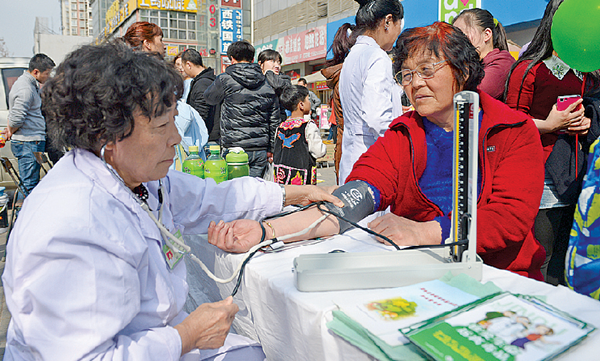
A doctor working at a community healthcare center in Xi’an, Shaanxi province, measures a woman’s blood pressure. Provided to China Daily |
The reform, implemented in more than 3,600 medical institutions across the city, replaces the traditional registration fee, which was deemed too low for doctors, with higher medical service charge, while reducing the fees for the use of equipment such as computed tomography and nuclear magnetic resonance but increasing the charges for certain medical services that require high level of experience, expertise and/or staff time, including acupuncture. The reform also eliminates the practice of drug price markup by hospitals, which was as high as 15 percent. The public response, however, has been one of concern.
After the reform, the cost of consulting a doctor has increased, but the overall charge paid by patients for medication has declined, according to media reports. The change in the behavior of doctors brought about by the reform is that they have become more cautious in prescribing medicines leading to lower medication costs.
The Beijing move is seen as a pilot for a nationwide medical reform given that the country faces the challenge of rising medical charges that have increased the financial burden of patients. More provinces and regions are expected to launch similar reforms, learning from the experiences gained from the Beijing program.
Like any other reform, Beijing's move has triggered some complaints from the people, who argue that while they have to spend much more to consult a doctor, their overall medical cost has not dropped as significantly.
Still, the Beijing reform is moving in the right direction as it boosts the morale of doctors by increasing their incomes. Previously, a patient needed to pay only 2 yuan (29 US cents) to consult a doctor in a public hospital, which didn't match the expertise and labor of the doctors and, regrettably, became a reason for them to accept kickbacks from drug dealers in exchange for prescribing excessive medicines. Now the medical service charge (replacing the previous registration fees) has been raised to 10 yuan for young doctors, and up to 40 yuan for experienced doctors.
The elimination in drug price markups in hospitals is also an encouraging move, as people had been complaining about high medication costs.
However, the reform is far from complete. It only tackles problems that occur in hospitals and fails to solve those plaguing the long chain of medicine supply. Although drug price markup by hospitals was a key reason for the exorbitant medication costs, it was not the main factor of the overall problem of exorbitant medical costs. The main problem lies in the circulation process, where, in some cases, the bidding price of a drug accepted by a hospital could be 10 times more than the general market price. The enormous profits made from the price gaps are shared by pharmaceutical companies, intermediary medicine dealers, and hospital staff, including kickbacks for doctors. Worse, the inflated medication costs are paid from public funds (through medical cost reimbursement) and by patients.
Many media reports in recent years have revealed the dirty tricks in the drug supply chain that have greatly pushed up the final sales price of medicines in hospitals. Although the authorities have taken several measures to deal with the problem, the situation has not improved much and public complaints keep mounting.
If the authorities are indeed serious about solving the high medical cost problem, they should take real measures to better regulate the industry and prevent the prices of medicines sold through hospital dispensaries from increasing wildly.
The author is a senior writer with China Daily.
xinzhiming@chinadaily.com.cn