Distance, discord dupe us into denying doom
 |
|
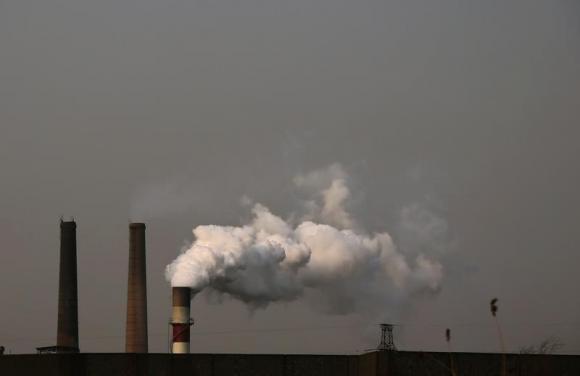
Smoke rises from a chimneys of a steel mill on a hazy day in Fengnan district of Tangshan, Hebei province February 18, 2014.[Photo/Agencies] |
Why are we humans so bad at thinking about facts, facts such as those on climate change, even when more and more research proves them?
The answer is provided by Pep Espen Stoknes, the author of What We Think About When We Try Not to Think About Global Warming. Stoknes studied hundreds of peer-reviewed social science studies and identified five main barriers that prevent climate messages from drawing people's attention as much as they should.
He calls them "the Five Ds": Distance, Doom, Dissonance, Denial, and iDentity. "I had to cheat a little bit with the last D-I lost one there-but it was the closest I could get," he admits.
Since climate change is almost always presented as a distant reality, both in time and space-for example, when we talk about what would happen in 2050 or 2100-people tend to believe the phenomenon is eons away.
The vanishing of the Congo, Southeast Asian and Amazon rainforests, and the melting of the Arctic and Antarctic are accompanied by the vanishing of the doom factor as they seem to have little or no bearing on human life today.
Dissonance, says Stoknes, may be an even bigger problem. When we know what we should do conflicts with our everyday life, we tend to ignore it without thinking about the ultimate consequences. And not to feel like "hypocrites", we continue with our everyday activities like eating meat, driving a car, and traveling by plane.
The uneasy feeling that comes with dissonance makes many turn to denial. And some tend (or pretend) to ignore climate change altogether because they feel individual action (or inaction) cannot make any difference.
This is where individual identity comes in. True, individual actions alone cannot solve the climate change problem. But it can make a difference to the future we leave behind for our children, at least in terms of human attitudes toward the planet we call home.
But to truly change the behaviors and attitudes of the people, "we need two things-awareness and motivation", says Magali Delmas, a professor at the Institute of Environment and Sustainability at the University of California, Los Angeles.
Delmas and her colleagues, in a recent study, put different messaging approaches with consumers to test. The subject was the use (or overuse) of electricity. They sent personalized emails to families with their monthly power bills, advising some how to save money and others how their energy consumption harmed the environment and their children's health.
The advice to save money proved a poor motivator. But by linking electricity use to pollution and thus to the rates of childhood asthma and cancer, the second approach led to an 8 percent decrease in the use of energy in households in general, and more than double in families with children.
Advice to save money may be a poor motivator. But suggestions on how to earn more money have exactly the opposite effect on people.
People's attitude toward climate change and money reminds one of The Little Prince by Antoine de Saint Exupery.
When the Little Prince reaches the fourth planet, he finds a businessman busy calculating numbers. "Phew! Then that makes five hundred and one million, six hundred and twenty-two thousand, seven hundred and thirty-one," sighs the businessman. The Little Prince asks: "Five hundred million of what?"
Seemingly busy, the businessman ignores the Little Prince's repeated questions until he is forced to say 501,632,731 "stars". And when the Little Prince asks what he does with the stars, he replies: "... I own them."
On further questioning, the businessman says he uses the stars to buy more stars, which makes him richer, even though they are of no practical use to him.
Realizing the toxic power of greed, the Little Prince tells himself: "Grown-ups are certainly absolutely extraordinary."
Indeed, we grown-ups are certainly absolutely extraordinary when it comes to ignoring climate change.
The author is a senior editor with China Daily oprana@chinadaily.com.cn