US, DPRK are key to denuclearization of Korean Peninsula
 |
|
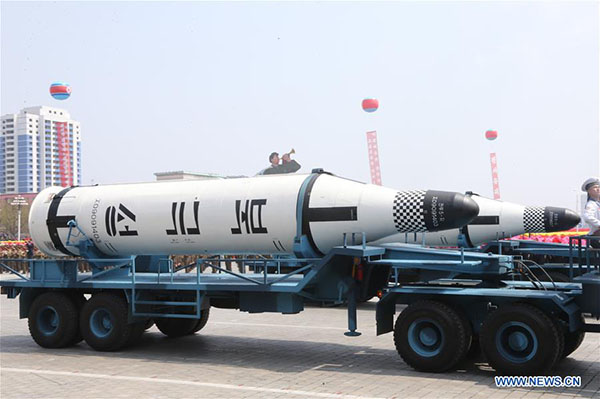
A submarine-launched ballistic missile is displayed during a military parade in central Pyongyang, April 15, 2017. [Photo/Xinhua] |
The DPRK's fifth nuclear test last September and its continued missile tests in the past months have violated the United Nations Security Council resolution and posed a threat to regional stability. More economic sanctions by the Security Council will be warranted if such violations continue.
The United States has not made the matter any better by flexing its muscles. On Wednesday, some 2,000 US and the Republic of Korea troops took part in a military drill just 30 kilometers south of the Demilitarized Zone, a day after the DPRK held its own artillery drill. The USS Carl Vinson and other warships are cruising toward the area in what US President Donald Trump earlier described as "an armada".
On Wednesday, Trump and his senior officials held a classified briefing with US senators. The words that came out of that meeting have been relatively moderate compared with the warmongering rhetoric in the past weeks. The US now says it aims to pressure the DPRK into dismantling its nuclear, ballistic missile and proliferation program by tightening economic sanctions and pursuing diplomatic measures with the US allies and regional partners.
It did not say what steps the US will take to ease the tensions, although starting to install the US' missile defense system in the ROK is not likely to do so.
There has been much talk in the US that actions by China will be essential. They believe China should cut off all economic ties with the DPRK. That is wrong-headed. China has implemented the UN Security Council resolution on the DRPK. It would be unreasonable and unrealistic for China to cut all economic ties, a move that will cause a huge humanitarian disaster and destabilize the region.
Some in the US even floated the idea to arm the ROK with nuclear weapons and encourage Japan to develop its own bombs. Some still believe that a military option is viable.
Such thinking can be summarized in one word: simplistic.
Those who believe that more economic sanctions will bring the DPRK to its knees have forgotten that all five DPRK nuclear tests since 2006 were conducted under the UN sanctions and the US unilateral sanctions. No one should assume that more sanctions will magically work.
China is deeply worried about a military conflict on the Korean Peninsula right on its border. Who would not be? The ROK and Japan, which host the US troops, are probably concerned that a war in the region will devastate their cities and people.
The US said it will not tolerate the DPRK having ballistic missiles that can hit US, but it has not addressed the DPRK's concern for its own security. Despite the US assurances that it is not pursuing regime change, such words have no credibility after the US invaded Iraq in 2003 to remove Saddam Hussein under the false pretext of weapons of mass destruction. Its regime change in Libya in 2011, ousting Moammar Gadhafi after he gave up his country's nuclear weapons program, will also have suggested to the DPRK that it should hold on to its nuclear program if it wants to prevent similar US aggression.
In this sense, the US should correct its mistakes, such as by signing a peace treaty with the DPRK, heeding the Chinese proposal to resume the Six-Party Talks, and implement the "two-suspensions": The US suspends its joint drills with the ROK while the DPRK suspends its nuclear test.
The key to denuclearization is in the hands of the DPRK and the US. China can help if both of them refrain from taking provocative actions.
The author is deputy editor of China Daily USA. chenweihua@chinadailyusa.com