Initiative marks transition of grand vision
 |
| LI MIN/CHINA DAILY |
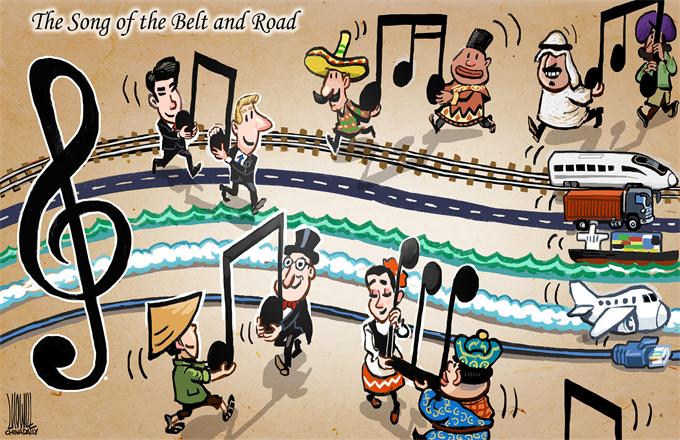
The Belt and Road Forum for International Cooperation marks a transition of high symbolism in President Xi Jinping's grand vision for a new era of win-win globalization. The core idea is to structure, finance and build critical infrastructure in developing economies, as well as diversify and expand the Chinese economy, which needs restructuring.
This is the fourth Belt and Road forum I will attend.
Xi announced the Silk Road Economic Belt as a "grand cause benefiting people in regional countries along the ancient route" in Kazakhstan in September 2013. In June 2014, I was asked to articulate the vision at the first Belt and Road forum in Urumqi, Northwest China's Xinjiang Uygur autonomous region. I described five categories: history, culture, trade, mutual development and peaceful development.
The second forum was in Quanzhou, Southeast China's Fujian province, in February 2015. It enlarged the vision to include the 21st Century Maritime Silk Road, engaging Southeast Asia, South Asia, the Middle East and East Africa.
The third forum was held in Xi'an, Northwest China's Shaanxi province, in September 2016, with the theme "Shared Memory, Common Development".
To comprehend Xi's Belt and Road Initiative, one must appreciate globalization, which is founded on the perennial law of comparative economic advantage but which is suffering discontent due to its differential impact on workers in Western countries. In a reversal of historic proportions, China now champions globalization, while the United States is now conflicted with "America First" protectionism.
China's developmental miracle is founded on globalization, as Chinese workers made China the low-cost manufacturing center of the world.
But China's old model no longer works-for one, workers must be paid higher salaries to rebalance severe socio-economic imbalances. China must develop new modes of globalization, leveraging its expertise and experience, especially in infrastructure construction, which is just what the developing economies need for their development.
The initiative is to expand links between Asia, Africa and Europe, and thus reduce imbalances in national development and promote global economic growth. It focuses on projects such as high-speed railways. Development comes first, China believes; nothing good can happen without economic growth.
The Beijing forum seeks consensus on major cross-regional projects, especially networks of roads, railways and shipping.
At the Xi'an forum, I chaired a session (on the media), which was held at precisely the same time as the first debate between US presidential candidates Donald Trump and Hillary Clinton.
"One hundred years from today," I began, "when the history of our times is written, our forum on the Belt and Road (Initiative) will carry more significance than the Trump-Clinton debate."
I was joking in one sense, but not in another. Why is the initiative so significant?
From the global perspective, poverty, under-development, and vast inequalities are deep, seemingly intractable problems-and economic development, catalyzed by infrastructure construction, is an essential part of the solutions.
From China's perspective, after decades of remarkable growth, economic transformation is necessary, and this includes geographical rebalancing within China and expanding China's trade by enhancing globalization.
All of these can be achieved by the initiative, but only if formulated synergistically and implemented assiduously. There are substantial challenges, of course-economic, financial, structural, political instability, nationalism, terrorism and, in certain circles, suspicion of China's motives.
But for sure, the world has great need and China has a grand plan in the Belt and Road Initiative.
The author is a public intellectual, political/economics commentator, and international corporate strategist.
- Inspur taps into Belt & Road
- Belt and Road holds key in Sino-German relations
- China to invest heavily in Belt and Road countries
- Belt,Road Initiative offers potential for most vulnerable
- US to send representatives to Belt & Road forum
- S.Korea to send delegation to attend Belt and Road forum in Beijing
- Belt and Road Initiative's popularity worldwide
- China welcomes Mongolia to actively participate in Belt and Road construction
- A new look: Belt and Road Initiative