First step toward using fire ice as new energy
 |
|
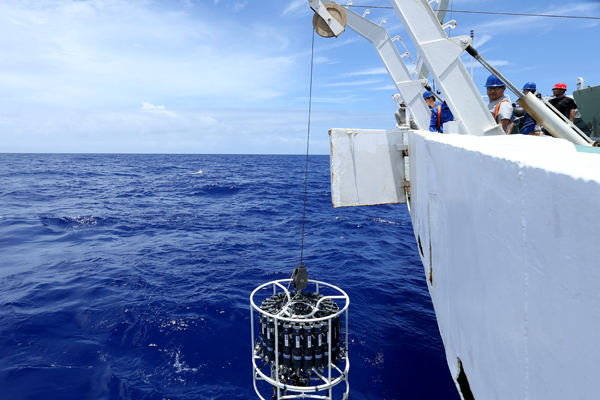
A device designed to gather data, including water temperature, salinity and depth, is readied for use on May 22, ahead of submersible Jiaolong's planned deep dives. Liu Shiping / Xinhua |
On May 18, the Ministry of Land and Resources announced that it had achieved success in drilling fire ice, or methane hydrate, from the seabed in the Shenhu area of the South China Sea. Methane hydrate is akin to methane gas trapped in ice-like crystals; it produces high amount energy when burned and its chemical reaction produces nothing but dioxide and water.
Since methane hydrate is both clean and energy-intensive and is considered the fuel of the future, many media outlets used big, bold headlines, such as "China makes technological breakthrough" and "New energy source found for China" to report the find.
In fact, it would not be an exaggeration to say China has indeed achieved a great technological breakthrough in the field.
Many countries, including the United States and Japan, have long been conducting research on methane hydrate, but extracting it from the bottom of the sea has been a common problem plaguing all of them. But, according to reports, the Chinese team succeeded in drilling methane hydrate for nearly eight successive days, with the average daily extraction exceeding 16,000 cubic meters, which is a big breakthrough.
However, it is too early to say a new energy source has been found. The world's total methane hydrate reserve is estimated to be about 21,000 trillion cubic meters, which if extracted could meet the world's energy need for 1,000 years. But the successful test drilling of methane hydrate does not mean it can be extracted for industrial use.
To extract enough methane hydrate for everyday use, the drilling technology must be successfully transferred from the laboratory to the industry. And for that, the two main challenges-environmental risk and economic cost-have to be overcome.
Methane hydrate is formed under high pressure and low temperature at the bottom of the sea, and it decomposes into methane and water when extracted from the seabed. That's disastrous for the environment because methane is one of the worst greenhouse gases. If methane is released in large volumes into the atmosphere, it will cause temperatures to rise further and intensify climate change.
Besides, the process to extract methane hydrate is very expensive as it involves highly advanced equipment and massive manpower. Considering that 1 cubic meter of methane hydrate provides the same amount energy that 164 cubic meters of natural gas does, the cost of using methane hydrate as an energy source is way too high.
Therefore, China has to solve many problems before it can use methane hydrate as a source of energy. But it can be said that China has taken the first big step toward solving those problems.
China's technological breakthrough is important because it shows the way researchers across the world should take. It also raises hopes that one day we can drill methane hydrate as a source of energy. With China achieving initial success in the field, researchers worldwide are expected to pay more attention to the subject, and if they make concerted efforts to find ways to extract methane hydrate without causing environmental damage, it can be used as energy earlier than thought.
Besides, at present studies on methane hydrate exploitation are sponsored mainly by states and the researchers hardly work with each other. With China taking lead in the field, hopefully international cooperation in research will become a possibility.
The author is the dean of China Institute for Studies in Energy Policy at Xiamen University. The article is an excerpt from his interview with China Daily's Zhang Zhouxiang.
- Breakthrough fuels hopes that fire ice is viable energy source
- Drilling expedition to answer questions deep in South China Sea
- World's most advanced drilling rig delivered in Yantai
- Shanxi launches first self-developed drilling platform
- China mulls 20 floating reactor platforms to aid oil drilling
- First drilling rig for North Sea finishes construction
- China's first drilling rig capable of working in Arctic ready to go