Asia needs deeper financial integration
 |
|
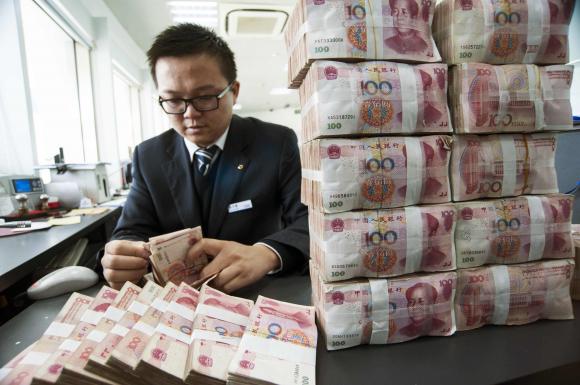
A clerk counts Chinese 100 yuan banknotes at a branch of China Construction Bank in Nantong, Jiangsu province, Dec 2, 2014. [Photo/Agencies] |
The ASEAN+3 Macroeconomic Research Office, the regional macroeconomic surveillance unit of the Chiang Mai Initiative Multilateralization, released the Regional Economic Outlook Report 2017 on Wednesday, the first release in China since its establishment in 2011.
The 1997-98 Asian financial crisis led to the creation of the Chiang Mai Initiative, and subsequently the CMIM, which in turn led to the establishment of the ASEAN+3 Macroeconomic Research Office.
In the 20 years since the Asian financial crisis, Asia has integrated itself in many aspects. But compared with trade and investment, the region's financial integration has lagged behind. According to the Asian Development Bank's Asian Economic Integration Report 2016, about 60 percent of Asia's trade is intra-regional but only 20 percent of financial flows are within the region.
There are many reasons for the poor financial integration: Asia's relatively less developed financial market and uneven financial openness across the region's economies. Besides, China could have become a leading regional financial player and market maker, but unfortunately, it has been struggling with the trade-off between financial openness and stability.
Poor financial integration has many downside effects on the region. It has been a drag on regional growth and reflects the misallocation of savings. Most Asian economies have high rates of savings-Singapore's household savings rate is more than 50 percent, China's nearly 50 percent and that of Malaysia, Indonesia and Thailand somewhere between 30 percent and 40 percent. Normally, high savings can be a driver for growth, as long as they are effectively transformed into investment.
Regrettably, Asia's high savings have been misallocated. They are recycled outside the region-about 70 percent to 80 percent has been invested in the United States, Europe and other regions. This is especially the case when it comes to portfolio flows.
Apart from such misallocation, Asia continues to face the challenge of excessive short-term capital flows that are pro-cyclical, speculative and risk-appetite driven. These factors have put Asia in a situation where accumulation of foreign exchange reserves is crucial as self-insurance against a possible sharp decline in the trade balance and rise of foreign debt.
In fact, Asia still sees the US dollar as an anchor; dollar assets remain the major destination of Asian investors' reserves. In short, Asia is still caught in the "dollar trap". Therefore, to strengthen its financial integration, Asia has to not only retain the savings within the region, but also reduce its reliance on the dollar.
China can play a key role in correcting the situation, by encouraging Asian economies to use their currencies for trade, investment and financial transactions. Adequate financial infrastructure, such as Credit Guarantee and Investment Facility, can provide support for banks and financial sectors to invest locally. More importantly, the ASEAN+3 Macroeconomic Research Office, together with the ADB, Asian Infrastructure Investment Bank and other regional arrangements, can contribute to regional financial stability and development, and facilitate regional financial cooperation.
Strengthening regional financial cooperation is also important for building a global financial safety net. Asia faces the challenge of dealing with massive capital flows. The fallout of long-lasting easy monetary condition makes the region extremely vulnerable, because the financial cycle dominates cross-border capital flows that are irrelevant to the real economy. Helene Rey, a professor at London Business School, has argued that traditional "trilemma" is dead; instead, central banks face a dilemma, that is, in her context, monetary policy's independence can be achieved only if capital flow is well managed. A debate on the subject is still going on, because capital flow is still sensitive to interest rate differentials and exchange rate policy still plays a vital role.
However, what really matters is the scale, volatility and a potential sudden stop of capital flow, as was seen during the Asian financial crisis. In such cases, a strong global financial safety net would be needed for minimizing the damage and preventing contagion. There are layers of options, from foreign exchange reserves to bilateral currency swaps and from regional to global resources, for that. In this regard, the CMIM certainly plays a key role for Asia.
The author is a researcher with the Institute of World Economics and Politics, Chinese Academy of Social Sciences.
- Can Asia take the next step to high income?
- Belt and Road expected to propel Southeast Asia tech sector
- Asia-Pacific sees record tourism boom, with China leading charge
- Southeast Asia’s masterly cook gives authentic local delicacies in Suzhou
- IMF warns Asia of aging population
- Asia development banks share goals
- Chinese-led AIIB positive for infrastructure development in Asia: BOJ chief