Time US embraced a multipolar world order
 |
|
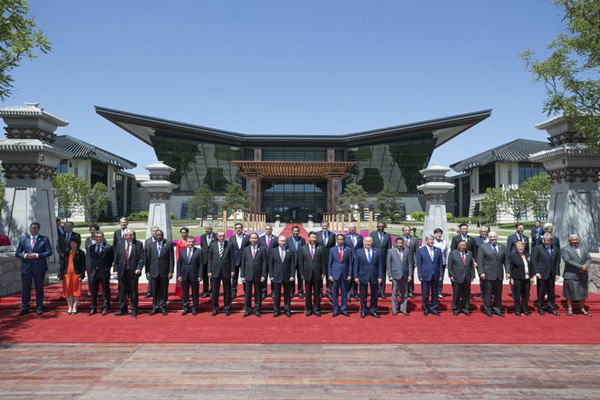
President Xi Jinping, foreign delegation heads and guests pose for a group photo at the Leaders' Roundtable Summit of the Belt and Road Forum for International Cooperation at Yanqi Lake International Convention Center in Beijing, May 15, 2017. [Photo/Xinhua] |
The Belt and Road Forum for International Cooperation, which concluded on May 15, was attended by representatives of both developed and developing economies, from the United States to Moldova. Washington's participation in the forum, however, is seen as a "sharp shift" in US foreign policy by some US scholars and strategists, who argue that the Belt and Road Initiative will grant China a bigger say in international rule-making at the expense of the United States.
This deduction is questionable, because the ultimate mission of the Beijing-proposed Silk Road Economic Belt and the 21st Century Maritime Silk Road is to improve the international order.
Since the end of the Cold War, Western powers have maintained a strong grip on global governance. On the one hand, they deserve credit for boosting regional growth and promoting globalization. On the other, their leadership has also widened global inequality and sparked economic crises.
That many developing countries have been left behind and their interests often overlooked goes against the pursuit of fairer, transparent global governance. Improvements, as those pursued by the Belt and Road projects, are therefore needed to overcome the institutional woes amid growing regional economic integration and deepening interdependence among economies.
The Belt and Road Initiative is essentially about economic integration and inter-connectivity, and it is largely immune to politicization. The participation of 29 heads of states in the Belt and Road Forum for International Cooperation reflects world leaders' determination to stimulate their economies' growth and improve people's livelihoods. It also explains why the inclusive vision of the Belt and Road Initiative has been welcomed by even economies not along the two routes.
Unlike many regional arrangements, the initiative aspires to achieve shared prosperity of economies despite their different stages of development, diverse political systems and cultures. Its ultimate aim is to eradicate poverty in less-developed economies to bridge divisions and create lasting peace. So some Western scholars' interpretation of the initiative in the context of geopolitical competition, which in fact is a key element of the West-led world order, is uncalled for.
The past decades have seen players involved in geopolitical games forming different camps based on their ideologies and belief in self-righteous causes. Political arrangements in the name of maintaining world peace, such as the Marshall Plan designed to boost Europe's recovery after World War II and contain the Soviet Union widened the Eurasian divide. There is no space for such a mindset in the Belt and Road Initiative. Instead, the initiative aims to improve infrastructure connectivity to help Eurasia prevent conflicts.
Therefore, US leaders and elites should embrace the multipolar world order and see it as a way to improve global governance. Emerging economies are playing a bigger part in stabilizing the world economy. The biggest challenge to Washington's leadership is its reluctance to embrace benign changes in the global rule-making mechanism, not the rise of China.
The progress made by the Belt and Road projects should help the US better understand what the international community really needs, so that it can handle its relations with China more constructively.
The author is a professor of US studies at China Foreign Affairs University.
- Xi, world leaders reach Belt and Road pacts
- Belt and Road Forum fuels energy deals
- Belt and Road needs global partners
- Xi, world leaders reach Belt and Road pacts
- Cui: Belt, Road on peaceful path
- From G20 Hangzhou Summit to Belt and Road forum, Xi's global prominence on the rise
- Belt and Road online database released in Shanghai